Expert GCSE Maths Tutors
One-to-one tutors in person across London and online worldwide, handpicked for your child's exam board.
Prefer to speak to someone?
Call us: +44 (0)207 736 6977- Tutors for AQA, Edexcel, OCR and every IGCSE board
- Handpicked by our education team and matched within days
- Rated 4.9 on Google · tutoring London families since 2010
Speak to our education team
Tell us what your child needs and we'll handpick their perfect tutor.
We reply to every enquiry within one working day. See our privacy policy.





Meet our GCSE Maths Tutors
Our expert GCSE maths tutors provide tailored support, ensuring students grasp complex concepts and excel in their exams. We focus on building confidence and fostering a love for maths, paving the way for academic success.

Tom
GCSE & A Level Specialist Tutor - Maths and PhysicsAs a Cambridge graduate with a distinction in his PGCE, Thomas brings both expertise and enthusiasm to his sessions. He is known for being patient and understanding of the unique l...

Jacob
GCSE & A Level Maths SpecialistHe particularly enjoys using real-world examples to both help understanding of a concept or to enable tutees to gain insight into why particular aspects of taught subjects are impo...

Sandip
Maths GCSE & A Level SpecialistOver the course of completing his PhD at King’s College London, Sandip gained a lot of experience in helping students across the Sciences, Arts and Humanities. Sandip aims to encou...

Mark
GCSE & A Level SpecialistMark specialises in guiding students through the middle and senior school years, including entrance tests at 11+ and 13+, GCSEs, A-levels and IB, with a focus on English, Maths and...

Guillaume
GCSE & A Level SpecialistGuillaume is a graduate from the University of Kent and Central Saint Martins. With over five years of teaching experience, he has helped numerous students achieve their goals. Spe...

Trausti
School Entrance, Mathematics, Interview Practice, GCSE Specialist, A Level SpecialistTrausti has 20 years’ experience as a teacher and headmaster, currently working in a North London prep school as Head of Mathematics after moving to London from his native Iceland ...

Ayman
University Admissions SpecialistAyman combines strong academic excellence with over 300 hours of tutoring experience across GCSE, A Level, and university application preparation, working with both private clients...

Georgia
GCSE & A Level SpecialistSince graduating from the University of Exeter, Georgia has tutored for over ten years and has taught a wide variety of subjects, specialising in GCSE and A Level English Literatur...
Sandip
7+, 11+ Entrance Exams, GCSE and A LevelSandip graduated with a History BA from Queen Mary University of London, he then completed his History MA, which specialised in Global, Imperial and Postcolonial History at the sam...
Want to see more tutors?
The tutors above are just a small selection of our GCSE Maths specialists. Tell our family education team what your child needs and we will send a personalised shortlist, with profiles, to choose from.
Exam Boards & Qualifications
Not all GCSE Maths courses are the same. Each exam board sets its own paper structure, question style and mark scheme, and a tutor who knows your child's board inside out can make a real difference to their confidence and their grade. Whichever specification your child is sitting, we match them with a tutor who teaches it regularly and knows exactly what examiners are looking for.

Edexcel (Pearson)
The most widely chosen board for GCSE Maths, popular in both state and independent schools for its clear, direct question style and the largest archive of past papers for exam practice.
AQA
One of the two most widely used GCSE Maths boards in England, known for accessible language and a confidence-building structure that opens each paper with short multiple-choice questions before building in difficulty.

OCR
Favoured by many schools for its emphasis on reasoning and applying maths in longer, context-rich problems; its papers are marked out of 300 rather than 240, with the non-calculator paper sat in the middle of the series.

WJEC / Eduqas
The main board in Wales and used by some English schools, with its own distinctive paper structure and a strong focus on functional, real-world application.
IGCSE Maths
We also tutor Pearson Edexcel IGCSE Maths and Cambridge (CAIE) IGCSE Maths. The Edexcel route is a linear international qualification assessed entirely by final exams, closely aligned with the UK GCSE and a natural fit for students heading towards A Level. Cambridge is widely taught in independent and international schools, offering Core and Extended tiers to suit a range of abilities, with an optional Additional Maths pathway for the most able students.
What Our GCSE Maths Tuition Covers
Number
The foundation the whole subject rests on: fractions, decimals, percentages, indices, standard form and the arithmetic every later topic depends on…
MoreLess
The foundation the whole subject rests on: fractions, decimals, percentages, indices, standard form and the arithmetic every later topic depends on. Gaps here often explain why a student struggles elsewhere, because algebra and ratio both assume this fluency.
Our tutors check these fundamentals early and rebuild any weak areas before moving on, so that the harder material has something solid to sit on. For students who are already secure, we move quickly to the exam-style questions where number skills are tested under time pressure.
Algebra
The area that most often separates a grade 4 from a grade 7 and above: expanding, factorising, solving equations, rearranging formulae, sequences and graphs…
MoreLess
The area that most often separates a grade 4 from a grade 7 and above: expanding, factorising, solving equations, rearranging formulae, sequences, simultaneous equations and graphs. Higher tier extends this to quadratics, inequalities and functions.
Algebra rewards understanding over memorisation, so our tutors focus on why each method works, not just the steps. Once a student can see the structure behind a question, unfamiliar problems stop feeling like new material and start looking like variations on what they already know.
Geometry & Measures
Angles, shapes, area and volume, Pythagoras, trigonometry, transformations and constructions, tested through both short recall questions and longer reasoning problems…
MoreLess
Angles, shapes, area and volume, Pythagoras, trigonometry, transformations, vectors and constructions, tested through both short recall questions and longer multi-step reasoning problems. Higher tier adds circle theorems and more demanding trigonometry.
This is an area where careful diagram work and setting out each step clearly earns marks that are otherwise lost. Our tutors show students how to annotate diagrams, choose the right method and present their reasoning in the way examiners reward.
Ratio, Proportion & Rates of Change
One of the most heavily weighted areas of the current GCSE: sharing in a ratio, direct and inverse proportion, scale, compound measures such as speed and density, and rates of change…
MoreLess
One of the most heavily weighted areas of the current GCSE: sharing in a ratio, direct and inverse proportion, scale, compound measures such as speed and density, percentage change and rates of change. These topics appear across many exam questions, often combined with algebra or geometry.
Because the questions are frequently set in real-world contexts, students need to translate a worded problem into maths before they can solve it. Our tutors give plenty of practice at that first step, which is where many marks can be won.
Probability
Calculating and comparing likelihoods using tree diagrams, Venn diagrams, frequency tables and sample space, including the conditional probability tested at Higher tier…
MoreLess
Calculating and comparing likelihoods using tree diagrams, Venn diagrams, frequency tables and sample space, including the conditional probability tested at Higher tier. The methods are approachable, but the wording of questions can trip students up.
Our tutors focus on reading each question carefully, choosing the right diagram and laying out the working so that method marks are secured even when a final answer slips. Probability is an area where a clear, consistent approach pays off quickly.
Statistics
Collecting, representing and interpreting data: averages and spread, cumulative frequency, box plots, histograms and scatter graphs, and drawing sound conclusions from data…
MoreLess
Collecting, representing and interpreting data: averages and spread, cumulative frequency, box plots, histograms, scatter graphs and comparing distributions. Students are asked both to construct these accurately and to interpret what they show.
The interpretation questions carry marks that are often left on the table, because students produce the graph but do not comment on it fully. Our tutors show them how to read a dataset, describe it in the right language and back up each conclusion with evidence.
Problem-Solving & Exam Technique
Knowing the content is only half of a GCSE Maths grade. The rest comes down to where marks are lost: showing working, multi-step problems and time management…
MoreLess
Knowing the content is only half of a GCSE Maths grade. The rest comes down to where marks are lost: showing full working so method marks are earned even when an answer is wrong, breaking multi-step problems into manageable stages, and managing time so that no question is left unattempted.
Our tutors work through past papers with students to build these habits under exam conditions. Over a few sessions this steadies performance, turning the marks a student can access on a good day into the marks they reliably score on the day itself.
GCSE Further Maths
For students targeting grades 8 and 9 or heading towards A Level Maths, we also support GCSE Further Maths, which extends beyond the standard syllabus…
MoreLess
For students targeting grades 8 and 9, or heading towards A Level Maths, we also support GCSE Further Maths (and Additional Maths on some specifications). These qualifications extend beyond the standard GCSE into more advanced algebra, calculus and trigonometry, and bridge the gap to sixth form study.
Our tutors for this level are chosen for their strength with the most able mathematicians. They stretch students with harder material while keeping the core GCSE secure, so that a strong grade and a smooth transition to A Level go hand in hand.
Whatever the goal, your family is not working it out alone.
Whether your child is rebuilding confidence, pushing from a 6 towards an 8 or 9, or preparing for a resit, we will find the right tutor and stay involved right through to results day.
How We Pick Your Perfect Tutor

We start by understanding your child and their goals.
Every GCSE Maths student is in a different position, whether that is rebuilding confidence after a tough mock, pushing from a grade 6 towards an 8 or 9, or preparing for a resit. After an initial discussion with you, we assess exactly what your child needs, including their exam board, their tier and where they are losing marks, before we begin the search for the right tutor.

We select the tutor best suited to your child, academically and personally.
With a clear picture of the student, we approach the GCSE Maths tutors we feel are right for the assignment. We weigh up each one based on their availability, experience with the relevant exam board, qualifications, and manner, so that the match works for both your child's learning goals and your family's requirements.

We introduce you to your handpicked tutor.
We send you a shortlist with all the information you need to make a confident decision. If you would like advice on which tutor would suit your child best, our education team is always reachable by phone or email and happy to talk it through with you.

Your tutor builds a bespoke GCSE Maths plan.
Over the first few sessions, your child's tutor assesses their current level across the syllabus and identifies the specific topics holding their grade back. Your child then receives a clear plan built around their target grade, their exam board and the areas that will make the most difference, with progress reviewed as they go.

We stay in touch throughout with regular check-ins.
From the first session to the final exam, our Client Services team keeps in contact with you. Consistent progress matters to us, and we make sure the family, the student and the tutor are all happy with how the tuition is going.
Secure a GCSE Maths tutor for your child
A quick chat is all we need to understand what your child is aiming for and start the search. There are no registration or agency fees.
What Our Clients Say About Our GCSE Maths Tutors
Mr L London (Online)
“Following GCSE results day last week, we wanted to thank you for the Maths tutoring in the last year you provided for M. He got some very good results. M achieved 8s and 9s + equivalents across all his 11 GCSEs!”
Mrs T Brent Cross
"Trausti has been perfect. He is so organized, helpful and knowledgeable and very patient. He clearly has a deep understanding of the curriculum and teaches it in such a way that my daughter has really improved significantly and is now on course to achieve the grade she wants in Maths. What has been so impressive is his ability to identify the areas that require work and after assessing to improve these "dodgy" areas with practice papers and tuition. He is meticulous and that is what is required at this stage - he is much appreciated!"
Mrs W Wandsworth
"I have been meaning to contact you to say thank you for providing Alex to help with T's maths. He is a very nice personable and conscientious young man and he and T got on really well. She definitely felt much more confident by the end, so let's hope all the hard work from both parties has paid off!"
FAQs
Free Maths GCSE Resources
If you need help with your GCSE Maths revision, check out our free exam guides, revision guides, and other resources below.

How to Revise GCSE Maths: A Complete Guide for 2026
The most effective way to revise GCSE Maths is to practise, not to re-read. Working through exam-style questions by topi...

GCSE Maths Exams Explained
Along with English and Science, GCSE maths remains a compulsory exam for all students in England and Wales. A strong per...

IGCSE vs GCSE: Differences You Should Know in 2026
The General Certificate of Secondary Education (GCSE) or international equivalent (IGCSE) exams are traditionally sat a...

A Complete Guide to Every GCSE Exam Board
The GCSE (General Certificate of Secondary Education) system in the UK is overseen by various exam boards. Each of these...
Free GCSE Revision Timetable Template
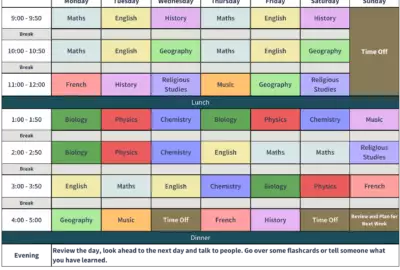
A good revision timetable will ensure you have a plan to cover all the topics you need to cover. You will have been stud...

The Ultimate Guide to GCSE Revision
GCSEs are a pivotal moment for students as they enter a new phase of academic challenges and personal growth. As these e...

How to Get All 9s in your GCSEs?
How to Get All 9s in your GCSEs? Achieving all 9s in your GCSEs is an exceptionally impressive achievement. It demonstr...

GCSE Grading Boundaries Explained: A Comprehensive Guide for Parents
The General Certificate of Secondary Education (GCSE) exams are a pivotal moment in every UK student’s academic journey,...