Expert Insights
How to Revise for GCSE Chemistry: A Complete Guide
Published 14th August 2026 by Alastair

Chemistry is often the GCSE science that students find most challenging. There is a lot to remember, but there are also calculations, practicals. and unfamiliar questions to deal with, often within the same exam. For many students, the challenge is not simply learning the content. It is learning how to apply it under exam conditions.
The good news is that GCSE Chemistry becomes much more manageable with the right approach. Rather than simply reading through a revision guide from beginning to end, students should work from their exam board's specification, make time for both knowledge and calculations, and practise applying what they know to unfamiliar questions.
It is also important not to leave practical work until the last minute. Although there is no separate practical exam, questions about experiments, variables, results and methods can appear in the written papers.
In summer 2025, there were 174,088 entries for GCSE Chemistry across the UK. Of these, 91.5% achieved grade 4 or above and 46.1% achieved grade 7 or above (JCQ, 2025). Combined Science: Double Award, which is taken by considerably more students, recorded 989,264 entries.
This guide explains what students can expect from GCSE Chemistry, including the different exam boards, the differences between separate Chemistry and Combined Science, the required practicals, calculations, command words and six-mark questions. It also looks at practical ways to organise revision across all three sciences.
And, if you're looking for GCSE Chemistry Tutors, then Ivy Education are here to help.
GCSE Chemistry is assessed through written examinations taken at the end of Year 11. There is no coursework and no separate practical assessment. However, practical knowledge is still an important part of the exams, with questions testing students' understanding of experiments and practical techniques.
All three main exam boards offer Foundation and Higher tiers. Foundation allows students to achieve grades 1 to 5, while Higher allows grades 4 to 9. Schools decide which tier a student will take, usually using evidence from mock exams and their progress throughout Year 10 and Year 11.
Before making a revision plan, there are two things every student should establish:
There is considerable overlap between the qualifications, but they are not identical. The paper length, number of marks, required practicals and depth of content can all be different.
Your science teacher will be able to confirm which qualification you are taking, and the specification code can also be found on the front of your school's past papers.
Exam board and code |
Paper 1 |
Paper 2 |
Length, marks and weighting |
AQA Chemistry (8462) |
Topics 1 to 5: Atomic structure and the periodic table; Bonding, structure and the properties of matter; Quantitative chemistry; Chemical changes; Energy changes |
Topics 6 to 10: The rate and extent of chemical change; Organic chemistry; Chemical analysis; Chemistry of the atmosphere; Using resources |
1 hour 45 minutes, 100 marks, 50% of the GCSE per paper |
Pearson Edexcel Chemistry (1CH0) |
Topics 1 to 5: Key concepts in chemistry; States of matter and mixtures; Chemical changes; Extracting metals and equilibria; Separate chemistry 1 |
Topics 1 and 6 to 9: Key concepts; Groups in the periodic table; Rates of reaction and energy changes; Fuels and Earth science; Separate chemistry 2 |
1 hour 45 minutes, 100 marks, 50% of the GCSE per paper |
OCR Gateway Chemistry A (J248) |
Topics C1 to C3 and C7: Particles; Elements, compounds and mixtures; Chemical reactions; Practical skills |
Topics C4 to C6 and C7: Predicting and identifying reactions and products; Monitoring and controlling chemical reactions; Global challenges; Practical skills, with assumed knowledge of C1 to C3 |
1 hour 45 minutes, 90 marks, 50% of the GCSE per paper |
One thing that all three boards have in common is that Paper 2 builds on knowledge from Paper 1. For example, AQA states that atomic structure, bonding and quantitative chemistry underpin much of the later content. Edexcel examines Topic 1 on both papers, while OCR specifically states that Paper 2 assumes knowledge of Topics C1 to C3. This means students should not think of Paper 1 revision as something they can forget once that exam is finished. Chemistry is interconnected, and earlier topics, particularly calculations and fundamental concepts, continue to appear later in the course.
If your child is studying Combined Science, they will take six papers in total, with two papers covering each science. The qualification is awarded as a double grade, ranging from 9-9 to 1-1.
Separate Chemistry, sometimes referred to as Triple Science, gives students a standalone Chemistry GCSE, graded from 9 to 1.
The chemistry content overlaps considerably, but Combined Science papers are shorter, contain fewer marks and cover some topics in less depth. Some content is also specifically identified as being for separate Chemistry students.
The table below uses AQA as an example, although the general distinction is similar across the different exam boards.
|
Separate Chemistry (Triple Science) |
Combined Science: Trilogy (chemistry papers) |
Number of chemistry papers |
Two |
Two, out of six science papers in total |
Paper length |
1 hour 45 minutes each |
1 hour 15 minutes each |
Marks per paper |
100 |
70 |
Weighting of each paper |
50% of the Chemistry GCSE |
16.7% of the double award |
Grade awarded |
One grade from 9 to 1 |
A double award from 9-9 to 1-1 |
Required practicals in Chemistry |
Eight |
Six |
Content excluded |
None |
Anything marked Chemistry only, including titration calculations and the chemical tests for ions |
Resitting |
Chemistry can be resat on its own the following summer |
The full double award must be resat |
There is also an important point to be aware of if a student ever needs to resit a science GCSE. The November resit series covers English Language and Maths only, so a science resit means waiting until the following June.
That is one reason why Year 11 mock exams are useful. They give students an opportunity to identify areas that need attention while there is still plenty of time to improve.

Although Chemistry involves a lot of factual knowledge, students are not simply being tested on how much they can remember.
Every question is marked against one of three assessment objectives set by Ofqual:
There are two other requirements worth keeping in mind.
At least 15% of the marks in every GCSE science qualification must assess knowledge and skills gained through practical work. Chemistry also has a separate maths requirement, with at least 20% of the marks assessing mathematical skills.
In other words, around a fifth of a Chemistry GCSE involves calculations.
This has an important implication for revision. Students need to learn the content, but they also need to practise using it. Reading notes can help with remembering information, but it cannot replace answering questions, completing calculations and explaining scientific ideas.
Moles are at the centre of many Chemistry calculations. Once a student is comfortable moving between mass, relative formula mass and moles, they can begin to apply the same underlying method to reacting masses, concentrations and titration calculations.
The calculations worth practising regularly include:
There are a few simple habits that can help protect these marks.
Show every step of your working. Even if the final answer is incorrect, method marks may still be available. Examiners can also apply error carried forward, meaning an early mistake does not necessarily mean that every subsequent mark is lost.
Include units. Make a habit of checking that the unit is included whenever the question requires one.
Pay attention to significant figures. If the question asks for a particular number of significant figures, make sure your answer follows that instruction.
Finally, practise using a calculator. It can be tempting to do straightforward calculations mentally, but working through the process with a calculator is good preparation for the pressure of the real exam.
Students will not have to carry out an experiment in the exam hall. Instead, they may be asked questions about a practical they have studied during the course.
For example, they might need to:
AQA has eight required practicals for separate Chemistry, six of which also appear in Combined Science: Trilogy. Edexcel has eight core practicals for separate Chemistry and seven for the Chemistry section of Combined Science. OCR organises its practical work into Practical Activity Groups, assessed under Topic C7 on both papers.
The AQA practicals are listed below as an example. If your child studies Edexcel or OCR, make sure they revise the practical requirements for their own specification. The revision approach, however, is broadly the same.
Required practical |
Topic |
Paper |
1. Making salts: preparing a pure, dry sample of a soluble salt from an insoluble oxide or carbonate |
Chemical changes |
Paper 1 |
2. Titration: determining the reacting volumes of a strong acid and a strong alkali (separate Chemistry only; the concentration calculation is Higher tier) |
Chemical changes |
Paper 1 |
3. Electrolysis: investigating what happens when aqueous solutions are electrolysed using inert electrodes |
Chemical changes |
Paper 1 |
4. Temperature changes: investigating the variables that affect temperature change in reacting solutions |
Energy changes |
Paper 1 |
5. Rates of reaction: investigating how concentration affects rate, by gas volume and by colour change or turbidity |
The rate and extent of chemical change |
Paper 2 |
6. Chromatography: separating and identifying coloured substances, and calculating Rf values |
Chemical analysis |
Paper 2 |
7. Identifying ions: chemical tests for the ions in unknown single ionic compounds, including flame tests (separate Chemistry only) |
Chemical analysis |
Paper 2 |
8. Water analysis: analysing and purifying water samples from different sources, including pH, dissolved solids and distillation |
Using resources |
Paper 2 |
A useful way to revise each practical is to make sure your child can answer five questions without looking at their notes:
Creating a one-page summary for each practical using this structure can cover much of what students are expected to know.
Titration and chromatography deserve particular attention because they combine practical knowledge with calculations.

A revision guide can be useful, but the specification is the best place to start because it tells you exactly what students are expected to know.
Download the specification for your exam board and specification code, then work through each statement. A simple RAG rating can make this much easier:
This creates a revision list based on what your child actually needs to work on, rather than simply following the order of a textbook.
If your child is studying Combined Science, check which areas are marked as separate Chemistry only. There is little benefit in spending valuable revision time on content that will not appear in their exam.
Chemistry requires two slightly different types of revision.
Some information needs to be remembered. This includes definitions, ionic equations, test results, the reactivity series, functional groups and the composition of the atmosphere.
Other parts of Chemistry require students to develop a method through practice. Moles, concentration, yield and rates are good examples.
Flashcards and retrieval practice can work well for the first group. For calculations, students need to actually work through problems.
Looking at a worked example can make a calculation look straightforward, but it does not tell you whether you can do it yourself. Cover the answer and have a go.
Reading through notes and highlighting a revision guide can feel productive, but it does not necessarily show whether the information has been learned.
Active recall is a much more useful way to check this.
One simple approach is to close the book and write down everything you can remember about a topic. Once finished, compare it with your notes and identify anything you missed.
You can use a different colour to highlight the gaps. Those gaps then become a clear list of what to revise next.
Dunlosky and colleagues' 2013 review of learning techniques rated practice testing among the highest-utility strategies available to students.
Chemistry contains a lot of information that students simply have to remember. There is no obvious way to work out that a lit splint gives a pop with hydrogen, that copper carbonate is green, or that the halogens become less reactive down the group.
Spaced repetition helps students revisit this information at gradually increasing intervals.
Flashcards can be useful here, whether students use physical cards or an app such as Anki or Quizlet. Keep cards that are regularly answered incorrectly separate so that they can be revisited more frequently.
There are several areas of GCSE Chemistry where students need to remember lists of related information. Learning these as complete sets can make it easier to spot what you have forgotten.
For example, students can create a single revision page for:
Instead of reading the page repeatedly, cover it and try to reproduce the whole thing from memory.
GCSE Chemistry includes a number of diagrams that students may be asked to draw or interpret. These include dot-and-cross diagrams, ionic and covalent structures, reaction profiles, electrolysis cells, fractional distillation columns and practical apparatus.
Copying a diagram from a textbook is not the same as being able to draw it yourself.
Try drawing it from memory first. Then compare it with the original, identify anything missing and correct it. Over time, the diagram should become easier to reproduce accurately.
Some Chemistry topics can feel straightforward until you try to explain them.
Bonding, electrolysis and equilibrium are good examples. Asking your child to explain a process out loud can quickly reveal where their understanding becomes uncertain.
They could explain the topic to a friend, a parent or even an empty room. If they cannot explain the chain of reasoning clearly, that is a useful sign that the topic needs another look.
Precise scientific language matters in GCSE Chemistry.
For example, saying that "the particles move faster" is less precise than explaining that the particles have more kinetic energy, resulting in more frequent successful collisions with sufficient activation energy.
A useful approach is to keep a glossary for each topic and test definitions in both directions. It is also worth paying particular attention to terms that are easily confused, such as:
Revision does not always have to be done alone.
Working through questions with a friend can be particularly useful. Try swapping answers and giving each other three things that were done well and three things that could be improved.
Marking somebody else's six-mark answer against the mark scheme is also a useful exercise. It helps students understand what examiners are looking for and become more comfortable using mark schemes themselves.
For calculations, one student can set a question while the other works through the solution, then swap roles.
Words such as "state", "describe", "explain" and "compare" each require a different type of answer. Learning what these words mean can therefore make a surprisingly big difference.
Command word |
What the examiner wants |
State, Give, Name |
A short factual answer with no explanation. Give only the number of points asked for; extra material earns nothing and can lose the mark if it contradicts the correct answer. |
Describe |
What happens, or what the data shows. Quote figures from the graph or table and state the trend. No reasons are needed. |
Explain |
Reasons. Every point should contain "because", "so" or "therefore". An answer with no causal link is a description, however accurate. |
Compare |
Similarities and differences, with both substances referred to in the same sentence. Writing a paragraph on each in turn scores poorly. |
Suggest |
Application of what you know to an unfamiliar reaction or context. There is often more than one acceptable answer, and the mark scheme allows for it. |
Calculate |
The working, the answer to the number of significant figures asked for, and the units. Method marks are available even when the final figure is wrong. |
Determine |
A value obtained from data given in the question, such as a rate from a graph or a concentration from titration results, with the working shown. |
Evaluate |
Both sides weighed against the evidence given, followed by a justified conclusion. A conclusion with no reasoning caps the mark. |
Design, Plan |
A method another student could follow, naming the independent, dependent and control variables and saying how each is controlled. |
Extended-response questions are usually worth six marks and are marked in levels rather than simply awarding one mark for each correct fact.
Students therefore need to show a clear chain of reasoning rather than writing down everything they know about a topic.
A good approach is to spend a minute planning the order of the answer. Then write in full sentences, use precise scientific terminology and make the links between each stage clear.
Words such as "because", "so" and "therefore" can help students make those links explicit.
A list of correct facts may contain plenty of useful knowledge, but without explaining how those facts connect, it may not achieve the highest marks.
For shorter questions, another useful habit is to look at both the command word and the number of marks available. A four-mark question will usually require several distinct points. Repeating the same idea in different words will not normally earn additional marks.

Past papers are one of the most useful resources available to GCSE Chemistry students, but they are often introduced too late.
Once a topic has been taught in class, start with questions on that particular topic. This gives students an opportunity to apply what they have just learned.
As the exams approach, move towards complete papers under timed conditions, particularly from the spring term onwards.
When marking a paper, be honest. Use the published mark scheme rather than giving yourself the benefit of the doubt.
For every lost mark, try to identify why it was lost. Was it:
something you did not know?
a command word you misunderstood?
working that you did not show?
a missing unit?
a calculation method you could not remember?
After completing several papers, patterns should start to emerge. Those patterns are more useful than simply looking at the overall percentage.
Examiners' reports are another resource that students often overlook. They explain what students commonly got wrong and what examiners were looking for in stronger answers.
Reading the examiner's report after completing a paper can therefore help students understand not just which answers were wrong, but why they were wrong.
AQA and Edexcel separate Chemistry papers give students 105 minutes for 100 marks, while OCR gives 105 minutes for 90 marks. This works out at roughly a minute per mark, with some time available for checking.
One common problem is getting stuck on a lengthy calculation.
If a calculation is taking too long, leave it and move on. There may be several easier marks later in the paper. Come back to the difficult question once the rest of the paper is complete.
Students are also given a periodic table in the exam, and each board provides the data it expects students to use. Check with your child's teacher what appears on their board's data sheet. There is no need to spend revision time memorising information that will already be provided.
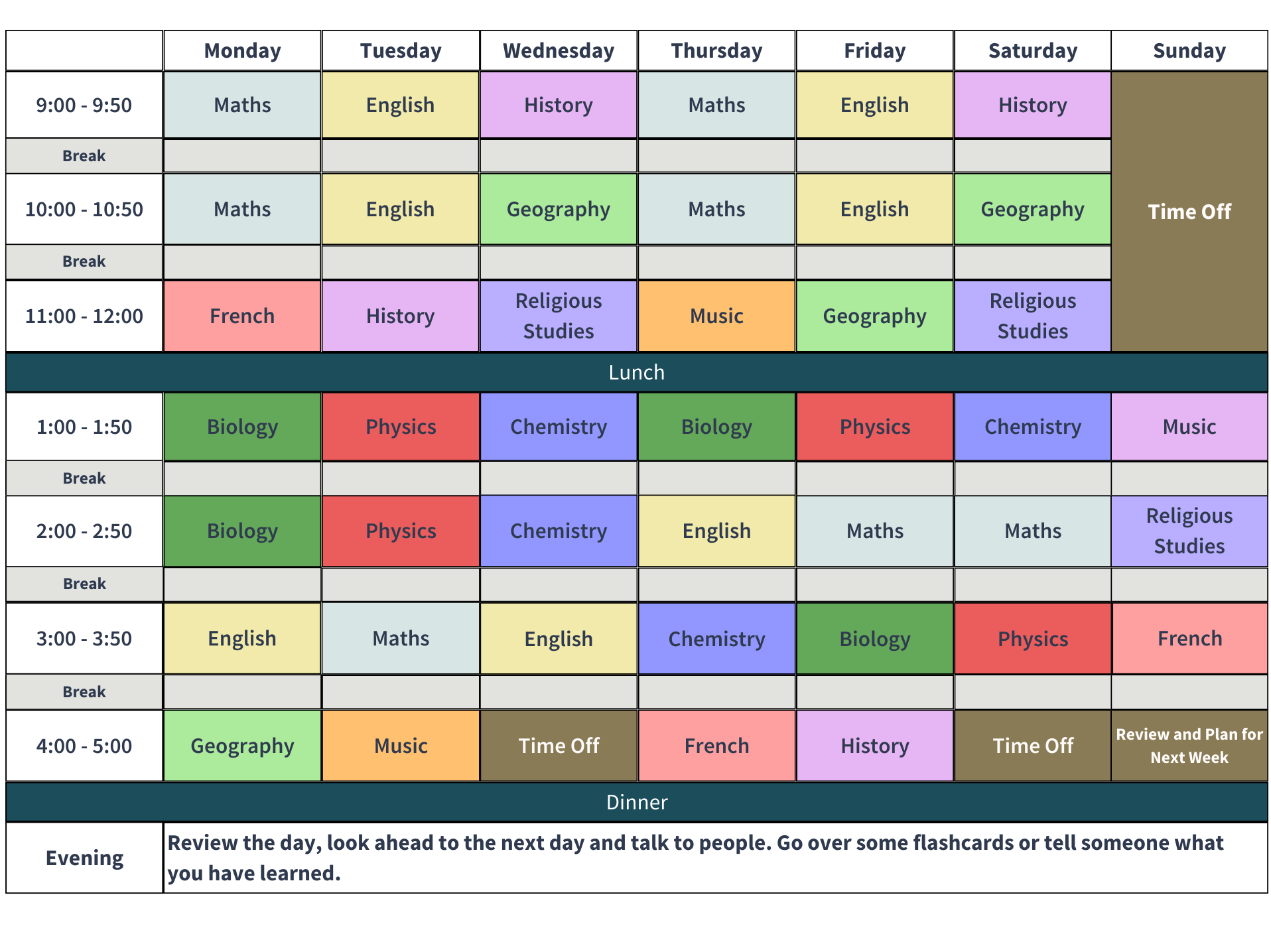
Chemistry is rarely studied on its own. Whether a student takes Triple Science or Combined Science, they are preparing for multiple science papers alongside all their other GCSE subjects.
Chemistry also needs two different kinds of revision: remembering information and practising calculations.
Rather than spending a whole week on one science or topic, try rotating subjects and topics throughout the week. This gives students regular opportunities to revisit material and reduces the temptation to focus only on subjects or topics they enjoy.
For Chemistry specifically, it is worth including some calculation practice in every session, even if it is only a short exercise. Calculation skills can fade when they are not used regularly.
Revision sessions do not need to be hours long. Around 30 to 45 minutes of focused work followed by a proper break can be more manageable than trying to complete marathon revision sessions at the weekend.
It is also worth starting earlier than you might think. Revisiting Year 10 Chemistry for a short period during the autumn of Year 11 can make the final months much less stressful.
Sleep, food and time outdoors should be part of the revision plan too. They are not rewards for finishing revision. They are part of helping students work effectively.
Ivy's free GCSE revision timetable template can provide a useful starting point for families creating a revision plan from scratch, while our Ultimate Guide to GCSE Revision looks at the wider process of preparing for exams.
Identifying these topics early gives students time to work on them before they become a problem in a mock exam or the real thing.
Moles are one of the areas that can have a significant impact on a Chemistry grade.
The key is regular practice. Start by becoming comfortable moving between mass, relative formula mass and moles in both directions. Then build on this with reacting masses, concentration, yield and titration calculations.
Ten calculation questions a week from October onwards can be more valuable than trying to learn all of the calculations in a few weeks before the exams.
The challenge here is often not remembering the different types of bonding, but explaining how structure affects a substance's properties.
For each structure, create the same set of headings:
What particles are present?
What forces hold them together?
What is the melting point and why?
Does it conduct electricity and why?
Use this framework for giant ionic structures, simple molecular substances, giant covalent structures, metals and polymers.
It gives students a consistent way to approach many of the questions they will encounter.
Students can sometimes lose marks on electrolysis because there are several stages to keep track of.
Work through the process in the same order each time:
What is present in the solution or molten substance?
Which ion goes to which electrode?
Which substance is discharged and why?
What are the half equations?
It can also help to learn anode and cathode by what happens at each electrode rather than relying only on remembering the names.
Collision theory provides a useful link between these topics.
For rates of reaction, think about the frequency and energy of collisions and activation energy.
Reaction profiles should be practised from memory for both exothermic and endothermic reactions, including the activation energy.
For Le Chatelier questions, use the same process each time: identify what has changed, consider which direction would oppose that change, and then determine what happens to the yield.
Organic Chemistry is often a relatively memory-heavy part of the course, so learning the information in groups can make it easier to manage.
Students should learn the first four alkanes and alkenes, their formulae and structures, as well as the relevant functional groups, general formulae and reactions.
Cracking, combustion and polymerisation each involve a relatively small number of predictable question types, so practising these can build confidence.
Flame tests, precipitate colours, gas tests and anion tests are largely recall-based.
That makes them potentially straightforward marks, provided students have learned the complete set rather than remembering isolated facts.
Combined Science students should check which tests are included in their own specification before spending time revising them.

Many students can make significant progress in GCSE Chemistry with the right specification, past papers and a consistent revision routine.
However, there are some things that can be difficult to identify when revising alone.
For example, a student may know the Chemistry but repeatedly lose marks because they are not answering the question in the way the mark scheme requires. Alternatively, they may understand the theory but struggle with the same step in a calculation every time.
Working out whether a problem is a knowledge gap or an exam technique issue is important because the solution is different in each case.
For families looking for additional support, one-to-one GCSE Chemistry tuition with a specialist tutor can provide focused help with the areas where marks are being lost. A tutor can also help students build confidence with calculations, practical questions and extended responses.
Ivy Education tutors work with the AQA, Edexcel and OCR specifications and can tailor lessons to the exam board and qualification a student is studying.

A more effective approach is to start with the correct specification, identify the areas that need attention and combine different types of practice.
Students should:
Confirm their exam board and qualification
Work from the specification rather than relying solely on a textbook
Divide revision between factual recall and calculation practice
Treat required practicals as examinable content
Learn what the different command words are asking for
Practise answering questions and checking them carefully against the mark scheme
Complete full past papers under timed conditions as the exams approach
There is a lot of content in GCSE Chemistry, but it is manageable when students give themselves enough time to revisit it.
Regular calculation practice is particularly important. It is much easier to build confidence gradually than to leave moles and other calculations until a few weeks before the exam.
If you would like additional support, fill out our form below. Ivy Education can match your child with a specialist Chemistry tutor who understands their exam board and can focus lessons on the areas where they need the most help.
Secure a specialist GCSE Chemistry Tutor with Ivy Education
There are two written papers on all three main exam boards. AQA and Edexcel separate Chemistry papers are 1 hour 45 minutes and 100 marks each. OCR Gateway papers are also 1 hour 45 minutes, but are worth 90 marks each. Each paper is worth 50% of the qualification. If a student takes Combined Science, the Chemistry papers are shorter and form part of six science papers in total.
GCSE Chemistry has a reputation for being the hardest of the three sciences. This is partly because students have a substantial amount of information to remember, while at least a fifth of the marks also involve mathematical skills.
The subject is not necessarily more difficult than the other sciences. The challenge is that students need to be comfortable with both recall and calculations.
Regular calculation practice can make the subject much more manageable.
Start with the specification and RAG-rate each topic or statement according to how confident you are.
Then divide revision between active recall of the content and practical work on calculations. Past paper questions should become an increasingly important part of revision as the exams approach, and answers should be checked carefully against the mark scheme.
There is no single revision technique that covers everything in Chemistry. Simply reading through notes is unlikely to be enough.
At least 20% of the marks require mathematical skills, a figure set by Ofqual.
The main areas include moles, relative formula mass, concentration, percentage yield, atom economy, bond energies, rates from graphs and Rf values.
The most effective way is to practise rather than simply read through worked examples.
Start by learning the relationship between mass, relative formula mass and moles in both directions. Once this is secure, move on to reacting masses, concentration and titrations.
Always show your working. Method marks can still be awarded even when the final answer is incorrect.
Triple Science means studying separate GCSEs in Biology, Chemistry and Physics. Each subject receives its own grade from 9 to 1 and has its own two papers.
Combined Science covers all three sciences in less depth. Students take six shorter papers and receive a double award, ranging from 9-9 to 1-1.
Both qualifications can lead to A Level Chemistry, although individual sixth forms set their own entry requirements.
For each practical, students should be able to:
Write the method from memory in five or six steps
Identify the independent, dependent and control variables
Give a source of error and explain how it could be reduced
Sketch the expected results
Explain the chemistry behind the results
At least 15% of the marks in every GCSE science qualification relate to practical work.
Yes. A periodic table is provided on all boards, and each exam board publishes the data supplied with its papers.
Check with your child's teacher what appears on their particular data sheet. This helps students focus their revision on information they actually need to remember.
Take a minute to plan the answer before you start writing.
Aim for a clear sequence of connected scientific statements, using precise terminology and explaining how each point leads to the next. Words such as "because", "so" and "therefore" can help make the reasoning clear.
Six-mark questions are marked in levels, so simply listing correct facts is unlikely to achieve the highest marks. The examiner needs to see a logical explanation.
Light retrieval of Year 10 content from the autumn of Year 11 can be a good way to keep knowledge fresh.
This can then build into two to four focused revision sessions each week during the spring term.
Calculation practice should be spread throughout the year rather than left until the final few weeks. These skills are much easier to maintain than rebuild from scratch.
Yes, but normally only in the following summer examination series.
The November resit window covers English Language and Maths only. Students taking Combined Science must resit the full double award rather than resitting one science individually.
Many sixth forms ask for at least a grade 6 in separate Chemistry, while some ask for a grade 7. Requirements often include a grade 6 or 7 in Maths as well, given the mathematical content of A Level Chemistry.
Students taking Combined Science are commonly asked for grades 6-6 or 7-7.
Entry requirements vary between sixth forms, so always check the specific criteria for the school or college you are applying to.

Alastair Delafield is the Managing Director and founder of Ivy Education.
All Author Posts