Biology has more to learn by heart than any other GCSE science. It is a subject where knowing the broad idea is often not enough; students need to remember the specific details too, and that's what makes it tricky!
The most effective way to revise for GCSE Biology is to work from your exam board’s specification rather than a textbook, test yourself on the content instead of re-reading it, learn the required practicals, as thoroughly as the theory, and practise applying what you know to data you have never seen before. Biology has a reputation as the science you can memorise, but the papers are written specifically to test whether you can apply what you have memorised.
Speaking of tricky, in summer 2025 there were 183,539 entries for GCSE Biology across the UK, of which 89.4% achieved grade 4 or above and 43.5% achieved grade 7 or above (JCQ, 2025). Combined Science: Double Award, the larger qualification by some distance, recorded 989,264 entries, with 9.3% of those achieving grade 7 or above. With this guide, we can help you beat the curve.
This guide covers the paper structure for AQA, Edexcel and OCR, the difference between separate Biology and Combined Science, the assessment objectives, the required practicals, command words and six-mark answers, the maths content, and how to plan revision across three sciences at once.
By the way, Ivy Education has specialist GCSE Biology tutors who can help you turn that plan into a grade!
Before we begin...
What does the GCSE Biology exam involve?
GCSE Biology is assessed entirely through written exams taken at the end of Year 11. There is no coursework and no separate practical assessment, although your understanding of practical work is examined in writing on both papers. Every board offers the qualification at two tiers: Foundation, which awards grades 1 to 5, and Higher, which awards grades 4 to 9. Your school decides which tier you sit, usually on the strength of mock results, and confirms the entry in the spring of Year 11.
Before you plan anything, establish two facts: which exam board you sit, and whether you are taking Biology as a separate qualification (often called Triple Science) or as part of Combined Science. The content overlaps heavily, but the paper length, the mark totals, the number of practicals and the depth of the content all differ. Your science teacher can confirm both, and the specification code is printed on the front of every past paper.
| Exam board and code | Paper 1 | Paper 2 | Length, marks and weighting |
|---|---|---|---|
| AQA Biology (8461) | Topics 1 to 4: Cell biology; Organisation; Infection and response; Bioenergetics | Topics 5 to 7: Homeostasis and response; Inheritance, variation and evolution; Ecology | 1 hour 45 minutes, 100 marks, 50% of the GCSE per paper |
| Pearson Edexcel Biology (1BI0) | Topics 1 to 5: Key concepts in biology; Cells and control; Genetics; Natural selection and genetic modification; Health, disease and the development of medicines | Topics 1 and 6 to 9: Key concepts; Plant structures and their functions; Animal coordination, control and homeostasis; Exchange and transport in animals; Ecosystems and material cycles | 1 hour 45 minutes, 100 marks, 50% of the GCSE per paper |
| OCR Gateway Biology A (J247) | Topics B1 to B3 and B7: Cell level systems; Scaling up; Organism level systems; Practical skills | Topics B4 to B6 and B7: Community level systems; Genes, inheritance and selection; Global challenges; Practical skills, with assumed knowledge of B1 to B3 | 1 hour 45 minutes, 90 marks, 50% of the GCSE per paper |
Note what every board has in common: Paper 2 assumes knowledge of Paper 1. AQA publishes a list of key ideas that can be assessed on either paper, Edexcel examines Topic 1 on both papers, and OCR states outright that Paper 2 carries assumed knowledge of Topics B1 to B3. Treating Paper 1 content as finished the moment Paper 1 is over is one of the more expensive habits of the exam season.
2.0 Top
Separate Biology or Combined Science: What's the difference?
If you sit Combined Science you take six papers in total, two in each science, and the whole qualification is reported as a double award on a scale from 9-9 down to 1-1. The biology papers are shorter, carry fewer marks, cover the content in less depth and drop several required practicals. If you sit separate Biology you take two longer papers and receive a single grade from 9 to 1. The table below uses AQA as the example, though the pattern is similar across boards.
| Separate Biology (Triple Science) | Combined Science: Trilogy (biology papers) | |
|---|---|---|
| Number of biology papers | Two | Two, out of six science papers in total |
| Paper length | 1 hour 45 minutes each | 1 hour 15 minutes each |
| Marks per paper | 100 | 70 |
| Weighting of each paper | 50% of the Biology GCSE | 16.7% of the double award |
| Grade awarded | One grade from 9 to 1 | A double award from 9-9 to 1-1 |
| Required practicals in biology | Ten | Seven |
| Resitting | Biology can be resat on its own the following summer | The full double award must be resat |
One practical consequence is worth knowing early. The November resit series covers only English Language and Maths, so a science resit means re-entering the following June. That is a long time to wait, and it is a reason to treat Year 11 mocks as diagnostic rather than decorative.

What skills are examiners assessing?
Every question on every exam board is assessed against the same three objectives, set by Ofqual. AO1 accounts for 40% of the marks and tests students’ knowledge and understanding of scientific ideas, techniques and procedures. AO2 accounts for another 40% and tests how well they can apply that knowledge, including to practical situations. The remaining 20% is AO3, which focuses on analysing and evaluating information, drawing conclusions and suggesting improvements to experimental procedures.
There are also two requirements that affect the papers. At least 15% of the marks in every GCSE science qualification must assess knowledge and skills developed through practical work, while at least 10% of Biology marks must test mathematical skills. So students need to be prepared for questions that go beyond simply asking them to recall what they have learned.
This is important when it comes to revision. Learning the content is only the starting point. Students also need to practise applying it to unfamiliar questions, interpreting information and graphs, analysing results and explaining their answers clearly. That is often where the difference between knowing the material and turning that knowledge into marks becomes apparent.
4.0 Top
The required practicals, and how to revise them
You will not carry out an experiment in the exam hall. You will be asked to write a method, identify the independent, dependent and control variables, name a source of error, interpret a set of results you have not seen before, or suggest an improvement to somebody else’s procedure. AQA sets ten required practicals for separate Biology, seven of which also appear in Combined Science: Trilogy. Edexcel sets core practicals, of which eight apply to separate Biology and six to the biology section of Combined Science. OCR groups its practical work into Practical Activity Groups, assessed under Topic B7 on both papers.
The AQA list is set out below, since it is the most widely sat specification. Check your own board’s list if you sit Edexcel or OCR, but the revision method is identical.
| Required practical | Topic | Paper |
|---|---|---|
| 1. Microscopy: observing, drawing and labelling plant and animal cells with a magnification scale | Cell biology | Paper 1 |
| 2. Culturing microorganisms and measuring zones of inhibition (separate Biology only) | Cell biology | Paper 1 |
| 3. Osmosis: the effect of sugar or salt solutions on plant tissue | Cell biology | Paper 1 |
| 4. Food tests for sugars, starch, protein and lipids | Organisation | Paper 1 |
| 5. Enzymes: the effect of pH on the rate of amylase activity | Organisation | Paper 1 |
| 6. Photosynthesis: the effect of light intensity on the rate of photosynthesis | Bioenergetics | Paper 1 |
| 7. Reaction time: measuring the effect of a factor on human reaction time | Homeostasis and response | Paper 2 |
| 8. Plant responses: the effect of light or gravity on seedling growth (separate Biology only) | Homeostasis and response | Paper 2 |
| 9. Field investigations: population sampling using quadrats and transects | Ecology | Paper 2 |
| 10. Decay: the effect of temperature on the rate of decay of fresh milk (separate Biology only) | Ecology | Paper 2 |
For each practical, work until you can do five things from memory: write the method in five or six numbered steps, name the independent, dependent and control variables, state one specific source of error and how you would reduce it, sketch the shape of the expected results, and explain the biology behind why the results come out that way. A one-page summary per practical, built to that template, covers most of what the practical questions ask.

Revision techniques that work for GCSE Biology
Start from the specification, not the textbook
Download the specification for your board and code, then RAG rate every statement in it: green for confident, amber for shaky, red for not yet learned. That gives you a revision list ordered by need rather than by chapter, and it stops you spending three evenings on cell structure simply because it comes first. Re-rate the list every few weeks so you can watch the reds turn green, which is also the most reliable motivation available in February.
Use active recall instead of re-reading
Re-reading notes and highlighting a revision guide feels productive and produces very little. It builds familiarity with the page rather than knowledge of the content. Retrieval practice, where you close the book and write down everything you can remember, is consistently more effective; Dunlosky and colleagues’ 2013 review of learning techniques rated practice testing among the highest-utility strategies available to students. Blurt everything you know about a topic onto a blank page, then check it against your notes and mark the gaps in a different colour. Those gaps are tonight’s revision.
Space it out and keep coming back
Biology involves a lot of information that simply needs to be remembered. Knowing that amylase breaks down starch or that the pancreas releases insulin is not something you can work out from first principles in the exam; you need to have learned it. Spaced repetition is a useful way to keep that information fresh by revisiting it at gradually increasing intervals. Flashcards work particularly well for definitions, enzyme names, hormone functions and the stages of different processes, whether you use paper cards or an app such as Anki or Quizlet. Keep track of the cards you get wrong and return to them more often until you can recall them confidently.
Draw the diagrams from memory
GCSE Biology asks you to label, complete and interpret diagrams: animal and plant cells, the heart, the digestive system, the eye, a reflex arc, the nephron, a food web, a Punnett square. Copying a diagram from a textbook teaches you almost nothing, because your hand does the work and your memory sits it out. Draw it from memory instead, then compare it against the original and correct it in a different colour. Repeat until you can produce it cleanly, and label as you go so the terminology sticks with the picture.
Explain processes out loud
Genetics, homeostasis and protein synthesis are the topics students most often believe they understand until they try to write about them. Explaining a process aloud, to a friend, a parent or an empty room, exposes the exact point where the chain of reasoning breaks. If you cannot get from "blood glucose rises" to "glycogen is stored in the liver" without pausing, you have found the next thing to revise. Teaching a topic to someone who does not study biology is the strictest version of this test.
Build the vocabulary deliberately
Biology mark schemes often reward precise terminology. Saying “the water moves in” is less useful than explaining that “water moves into the cell by osmosis, down the concentration gradient”. Keep a glossary for each topic and test yourself in both directions: from the term to its definition, and from the definition back to the term. It is also worth focusing on pairs that are easy to mix up, such as diffusion and active transport, mitosis and meiosis, arteries and veins, genotype and phenotype, insulin and glucagon, and transpiration and translocation.
Use mind maps for the links, not the facts
Mind maps can be useful for organising large amounts of Biology content and showing how different ideas connect. Start with a central topic and build out the key processes, terms and examples around it. They are particularly useful for spotting gaps in your knowledge and turning a large topic into something more manageable to revise.
Work with other people
Swapping practice answers with a friend and giving each other three things that went well and three that would make it even better is a quick way to see how somebody else structures an explanation, and to pick up phrasing you would not have reached for yourself. Marking somebody else’s six-marker against the mark scheme also teaches you to read a mark scheme, which is a skill in itself.
6.0 Top
Command words and extended response questions
Examiners’ reports return to the same point every year: students who know the content still lose marks because they describe when asked to explain, or explain when asked to state. Each command word carries an expected answer shape, and matching it costs nothing.
| Command word | What the examiner wants |
|---|---|
| State, Give, Name | A short factual answer with no explanation. Give only the number of points asked for; extra material earns nothing and can lose the mark if it contradicts the correct answer. |
| Describe | What happens, or what the data shows. Quote figures from the graph or table and state the trend. No reasons are needed. |
| Explain | Reasons. Every point should contain “because”, “so” or “therefore”. An answer with no causal link is a description, however accurate. |
| Compare | Similarities and differences, with both things referred to in the same sentence. Writing a paragraph on each in turn scores poorly. |
| Suggest | Application of what you know to an unfamiliar context. There is often more than one acceptable answer, and the mark scheme allows for it. |
| Calculate | The working, the answer to a sensible number of significant figures, and the units. Method marks are available even when the final figure is wrong. |
| Evaluate | Both sides weighed against the evidence given, followed by a justified conclusion. A conclusion with no reasoning caps the mark. |
| Design, Plan | A method another student could follow, naming the independent, dependent and control variables and saying how each is controlled. |
Extended response questions, usually worth six marks, are marked in levels rather than by counting individual points. Examiners look for a logical sequence of connected scientific statements, not a list of correct facts. Spend a minute planning the order of your points, write in full sentences, use the correct terminology and link each step to the next. A bulleted list of accurate facts with no reasoning usually sits in the bottom band, which is a painful way to score two marks out of six on material you knew.
A simple habit helps everywhere else on the paper: read the command word, look at the number of marks, and make at least that many distinct points. If a question is worth four marks, four separate scientific statements are needed. Repeating one point in different words scores once.

The maths in GCSE Biology
Unfortunately (or, fortunately, if you are mathematically inclined), at least 10% of the marks require mathematical skills, and the same techniques appear year after year. The list is short enough to be worth learning properly:
Magnification calculations, including rearranging the formula to find image size or real size
Unit conversions between millimetres, micrometres and nanometres
Standard form and orders of magnitude
Percentages, percentage change and percentage gain or loss of mass
Means, medians, modes and ranges, and identifying anomalous results
Ratios and probabilities from genetic crosses
Rates calculated from a graph, and surface area to volume ratio
Estimating population size from quadrat data
Drawing a tangent and estimating the area under a curve, at Higher tier
Both papers allow a calculator (hooray!), so practise with one to hand rather than doing everything mentally and then losing marks on arithmetic under time pressure. Always write out the working: method marks are frequently available when the final answer is wrong, and answers given without units are routinely penalised.
8.0 Top
How to use past papers, mark schemes and examiners’ reports
Past papers are the most valuable resource in the subject, and most students reach for them too late and use them too passively. Start with topic-by-topic questions as soon as a topic is finished in class, so the practice tests recent learning, then move to full papers under timed conditions from the spring term onwards.
Mark your own paper against the published mark scheme, and be strict about it. Wherever you dropped a mark, write one line explaining why: content you did not know, a command word you misread, a point you made but did not develop, or working you failed to show. After three or four papers, a pattern emerges, and that pattern is far more useful than the raw percentage. Most students find that a third or more of their lost marks have nothing to do with gaps in knowledge.
Examiners’ reports are published alongside the papers and mark schemes and are consistently underused. They describe, question by question, what the majority of students got wrong and what a full-mark answer contained. Reading the report for a paper you have just sat is one of the fastest ways to raise your next score.
Timing deserves a mention of its own. AQA and Edexcel separate Biology papers give 105 minutes for 100 marks, and OCR gives 105 minutes for 90; in each case that is roughly a minute a mark with a margin for checking. Students who run out of time have usually overwritten on the early short-answer questions rather than lingering on the six-markers.
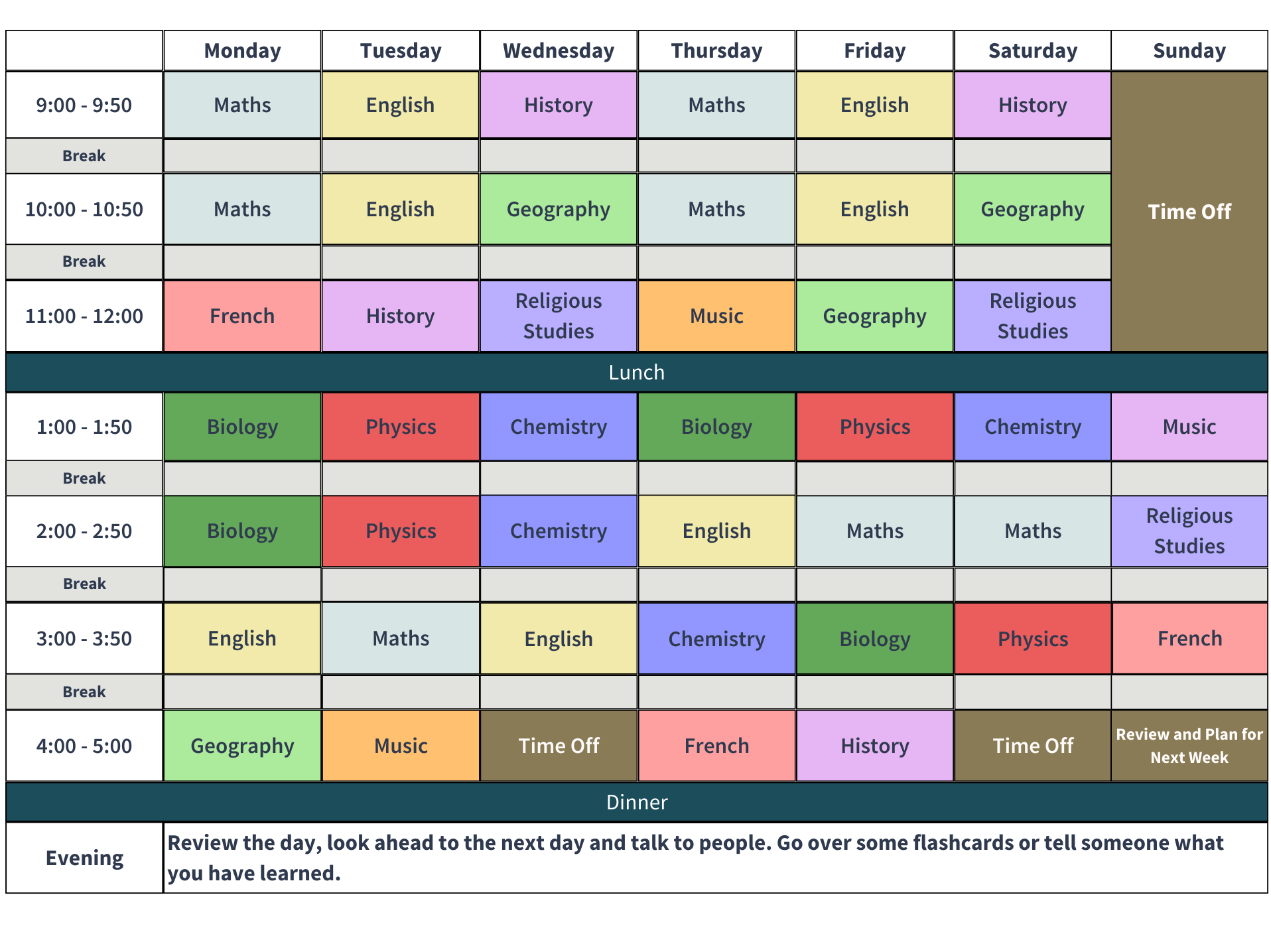
Building a revision timetable across three sciences
Biology is rarely revised in isolation. Whether you take Triple or Combined Science you are preparing for six science papers alongside every other subject, and biology carries the largest volume of content of the three by some margin.
Rotate subjects and topics across a week rather than spending a fortnight on one. Interleaving keeps material in memory and prevents the natural drift towards the topics you enjoy and away from the ones costing you marks. Weight extra sessions towards whatever is red on your RAG-rated specification, and revisit each topic often enough that the terminology stays fresh. Keep sessions short and regular, in the region of 30 to 45 minutes with a proper break afterwards, rather than attempting marathon days at the weekend.
Start earlier than feels necessary. Light retrieval on Year 10 content through the autumn of Year 11 costs an hour a week and removes most of the panic in April. Sleep, food and time outdoors belong in the plan rather than serving as a reward for finishing it.
Ivy’s free GCSE revision timetable template is a practical starting point if you are building a plan from scratch, and our Ultimate Guide to GCSE Revision covers the wider question of how to structure an exam season.
10.0 Top
The hardest GCSE Biology topics (according to us)
Genetics and inheritance
The vocabulary is dense and the reasoning is unfamiliar. Learn genotype, phenotype, homozygous, heterozygous, dominant, recessive and allele until they are automatic, then practise Punnett squares until you can set one up without thinking, including for sex-linked conditions and family pedigrees. Expressing outcomes as ratios, percentages and probabilities are three ways of saying the same thing, and questions switch between them freely.
Homeostasis
The difficulty here is that several negative feedback loops look almost identical on the page. Build one page per loop using the same headings every time: stimulus, receptor, coordination centre, effector, response, and the correction that follows. Blood glucose, body temperature and water balance then become variations on a structure you already know rather than three separate things to memorise.
Photosynthesis and respiration
Learn the word and symbol equations in both directions, and be clear that plants respire continuously rather than only at night; that misconception appears in examiners’ reports with some regularity. Limiting factor graphs are a reliable source of marks once you can explain which factor is limiting at each part of the curve and why the line plateaus.
Transport in plants and cells
Osmosis, diffusion and active transport are distinguished by three things: whether a partially permeable membrane is involved, the direction relative to the concentration gradient, and whether energy is required. Answer those three questions for each and the confusion largely resolves. Keep transpiration and translocation separate by tying each to its vessel, xylem and phloem respectively.
Ecology and sampling
Ecology is often taught last and revised least, which makes it a common source of dropped marks on Paper 2. Quadrat and transect method, estimating population size, calculating means per square metre, and interpreting food webs and trophic levels are all predictable and all learnable in a couple of focused sessions.
11.0 Top
Where a tutor helps
Most students can take themselves a long way in this subject with a specification, a set of past papers and the discipline to test rather than re-read. Three things are harder to provide for yourself: honest marking against the assessment objectives, feedback on why an answer sat in the second band rather than the top one, and somebody who can tell the difference between a knowledge gap and an exam technique problem. That distinction matters, because the two need entirely different remedies.
For families who want that structured support, one-to-one GCSE Biology tuition with a specialist tutor can concentrate revision on the topics and skills where marks are being lost, and can build the practical and extended-response technique that is difficult to develop alone. Our tutors know the AQA, Edexcel and OCR specifications and can work to whichever board your school has chosen.

Final thoughts
Revising for GCSE Biology comes down to a few principles. Confirm your board and your qualification, work from the specification rather than the textbook, test yourself rather than re-reading, treat the required practicals as examinable content in their own right, learn the command words, and practise full papers against the mark scheme. The volume of content is real, and it is manageable when revision starts early and every topic gets regular attention rather than a single heroic weekend.
If you would like tailored support, speak to Ivy Education’s team about matching your child with a specialist Biology tutor who knows your exam board inside out.
13.0 Top
FAQs
Two written papers on all three main boards. AQA and Edexcel separate Biology papers are 1 hour 45 minutes and 100 marks each; OCR Gateway papers are 1 hour 45 minutes and 90 marks each. Each paper is worth 50% of the qualification. If you sit Combined Science, the biology papers are shorter and there are six science papers in total.
Two written papers on all three main boards. AQA and Edexcel separate Biology papers are 1 hour 45 minutes and 100 marks each; OCR Gateway papers are 1 hour 45 minutes and 90 marks each. Each paper is worth 50% of the qualification. If you sit Combined Science, the biology papers are shorter and there are six science papers in total.
Work through the specification, RAG rating each statement, then use active recall and spaced repetition on your weakest areas. Combine flashcards for terminology, diagrams drawn from memory, and past paper questions marked honestly against the mark scheme. No single technique does the job on its own.
Triple Science means three separate GCSEs in Biology, Chemistry and Physics, each with its own grade from 9 to 1 and its own two papers. Combined Science is a double award covering the same three subjects in less depth, graded from 9-9 to 1-1 across six shorter papers. Both are accepted for A Level Science, though entry requirements differ.
For each practical, be able to write the method from memory in five or six steps, name the independent, dependent and control variables, state a source of error and how to reduce it, sketch the expected results and explain the biology behind them. At least 15% of the marks in every GCSE science qualification relate to practical work.
Yes. A scientific calculator is required for both papers on all boards. At least 10% of the marks involve mathematical skills, including magnification, unit conversions, percentages, rates and ratios.
Plan for a minute before writing, then produce a connected sequence of scientific statements in full sentences, using precise terminology and linking each step to the next with "because", "so" or "therefore". These questions are marked in levels rather than by counting points, so a list of correct facts with no reasoning scores poorly.
None of them is meaningfully easier, and in any case, the choice belongs to your school rather than to you. Grade boundaries are set each year to account for differences in paper difficulty. Time is better spent on the specification you sit than on comparing boards.
Light revision on Year 10 content from the autumn of Year 11 is ideal, building to two to four focused sessions a week from the spring term. Consistent short sessions beat a compressed programme in the final month, particularly in a subject where the content decays quickly without revisiting.
Yes, but normally only in the following summer series. The November resit window covers English Language and Maths only. Combined Science must be resat as a full double award rather than one science at a time.
Most sixth forms ask for at least a grade 6 in separate Biology, and many ask for a 7. Combined Science students are usually asked for 6-6 or 7-7. Requirements vary between schools, so check the specific criteria for the sixth form you are applying to.

BY Alastair
Alastair Delafield is the Managing Director and founder of Ivy Education.
All Author PostsOther Articles

The Ultimate Guide to GCSE Revision

A Complete Guide to Every GCSE Exam Board
Free GCSE Revision Timetable Template

How Many GCSEs Do You Need To Take?

How to Get All 9s in your GCSEs?

IGCSE vs GCSE: Differences You Should Know in 2026

GCSE Maths Exams Explained

What are IGCSEs?



How to Revise GCSE Maths: A Complete Guide for 2026

As featured in