Economics is one of those A Levels that seems to touch everything. Why has the price of your weekly shop crept up? Why does the Bank of England keep talking about interest rates? Why does a coffee in central London cost more than the same coffee in Leeds? A Level Economics gives you the tools to answer all of these questions, which is a big part of why it remains such a popular choice with sixth formers.
It is also a subject that surprises people. Students often arrive expecting either lots of maths or lots of essays, and quickly discover that it asks for both, along with diagrams, data skills and a steady supply of real-world examples. That mix is exactly what can make revision feel tricky at first.
This guide breaks it all down. We will walk you through what the course covers, how the exams work for each board, and the revision techniques that make the biggest difference to your grade. Whether you are in Year 12 finding your feet or in Year 13 with mocks on the horizon, there should be something useful here for you.
Before we begin...
What Does A Level Economics Cover?
Microeconomics: the small picture. How individual markets work, why prices rise and fall, how firms behave, and what happens when markets go wrong. Think pollution, monopolies, or why there never seem to be enough affordable homes.
Macroeconomics: the big picture. How the whole economy performs. This covers growth, inflation, unemployment, trade and the policies that governments and the Bank of England use to keep things on track.
Every exam board covers both halves. The difference lies in how the content is packaged into papers, which brings us neatly on to the next section.
2.0 Top
A Level Economics Exam Boards and Papers
There are three main exam boards for A Level Economics: AQA, Pearson Edexcel and OCR. All three assess the course through three written exams, each lasting two hours, sat at the end of Year 13 in May and June. There is no coursework, so everything comes down to those three papers.
Exam board and code |
Paper 1 |
Paper 2 |
Paper 3 |
Length, marks and weighting |
AQA Economics (7136) |
Markets and market failure: a data response question (choice of one from two) and an essay (choice of one from three) |
National and international economy: a data response question (choice of one from two) and an essay (choice of one from three) |
Economic principles and issues: 30 multiple choice questions and a case study drawing on the whole course |
2 hours, 80 marks, one third of the A Level per paper |
Pearson Edexcel Economics A (9EC0) |
Markets and business behaviour (Themes 1 and 3): multiple choice and short answer questions, a data response question and a choice of essay |
The national and global economy (Themes 2 and 4): multiple choice and short answer questions, a data response question and a choice of essay |
Microeconomics and macroeconomics: two data response questions drawing on all four themes, each with a choice of essay |
2 hours, 100 marks per paper; Papers 1 and 2 are worth 35% each and Paper 3 is worth 30% |
OCR Economics (H460) |
Microeconomics: a compulsory data response question followed by extended essays chosen from a selection |
Macroeconomics: a compulsory data response question followed by extended essays chosen from a selection |
Themes in economics: 30 multiple choice questions and questions based on unseen stimulus material from across the course |
2 hours, 80 marks, one third of the A Level per paper |
One thing all three boards have in common is that the final paper is synoptic. That is a fancy way of saying it can test anything from the whole course, and it expects you to link micro and macro ideas together.
For example, a question about a rise in the National Living Wage might ask you to think about the labour market (micro) and the effect on inflation and unemployment across the economy (macro) in the same answer.
This means you cannot treat Year 12 topics as finished once you move into Year 13. Supply and demand, elasticity and market failure keep reappearing right up to the final exam. If your school follows Edexcel Economics B (9EB0), the overall structure is similar, but Paper 3 is based on pre-released material, so it is worth checking the details with your teacher.

A Level Economics Exam Dates 2027
Economics has the honour (or the misfortune, depending on how you look at it) of opening the A Level exam season. Paper 1 is on the very first day of written exams, so it is worth planning your revision with that early start in mind.
For 2027, the exam dates for AQA and Edexcel are as follows:
Paper |
Date |
Day |
Paper 1 |
10 May 2027 |
Monday |
Paper 2 |
17 May 2027 |
Monday |
Paper 3 |
7 June 2027 |
Monday |
Papers are sat in either a morning or an afternoon session, and your school will confirm the exact start time for each one. The contingency day, which is kept free in case an exam has to be moved, is Wednesday 23 June 2027, so avoid booking any holidays before then. If you take OCR, check your dates with your school, as they may differ slightly.
Once the exams are over, A Level results day 2027 is Thursday 12 August.
4.0 Top
The Four Skills Examiners Are Looking For
They sound technical, but the idea is simple. Think of them as a ladder, where each step earns you more marks than the last:
Knowledge (AO1): Do you know the theory? Can you define key terms accurately?
Application (AO2): Can you use that theory in the context you have been given, rather than writing a generic answer?
Analysis (AO3): Can you explain, step by step, why something happens, ideally with a diagram?
Evaluation (AO4): Can you weigh up the arguments and reach a sensible judgement?
Most students are comfortable with the first two steps, but to get the absolute top grades, you need to get really quite good at the last two, which is why we spend a good chunk of this guide on them, so please keep reading!

Start With the Specification
You don't want to be revising for the wrong exam board, after all!
Then give yourself a quick health check:
Green: topics you could explain to a friend without notes.
Amber: topics you sort of understand but would wobble on in an exam.
Red: topics that make you want to close the laptop.
Your reds and ambers should be your first revision priority. It is tempting to keep revising the topics you already enjoy, but that feels productive without moving your grade very far.
6.0 Top
Diagrams: Your Secret Weapon
A well-drawn, fully labelled diagram shows the examiner in a few seconds that you understand the theory, and it gives your written analysis something to hang off. A messy or missing diagram, on the other hand, makes even a good explanation look shaky. Examiners regularly comment that students lose marks through unlabelled axes, curves shifting the wrong way, or diagrams that are drawn and then never mentioned in the text.
These are the diagrams that come up again and again, so make sure you can draw each one from memory:
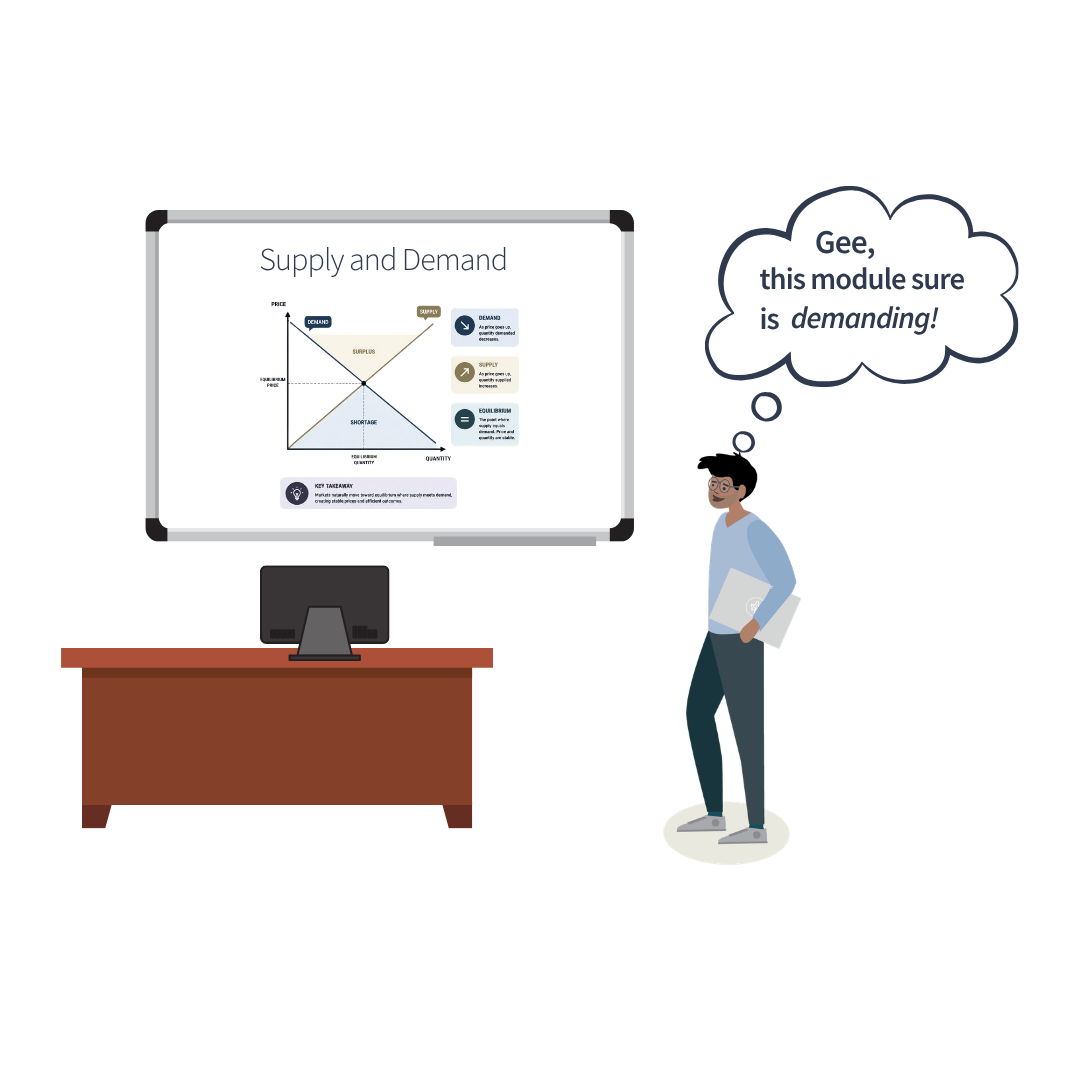
Supply and demand, including shifts in each curve
Price elasticity of demand and supply
Negative and positive externalities
Indirect taxes, subsidies and maximum and minimum prices
Cost and revenue curves, including perfect competition and monopoly
Labour market diagrams, including the minimum wage and monopsony
Aggregate demand and aggregate supply (AD/AS)
The Phillips curve and the Lorenz curve
Tariffs and the effects of trade
A good habit is to practise with a blank page and a timer. Draw the diagram, label every axis, curve and equilibrium point, then check it against your notes. Once you can do it quickly and accurately, add a short explanation underneath that refers to the points on the diagram (for example, “price rises from P1 to P2”).

Building Chains of Analysis
Analysis is all about explaining how one thing leads to another. Examiners call this a chain of reasoning, and every link in the chain earns you credit. Skip a link and you lose marks, even if your conclusion is correct.
Here is a simple example. Say the question asks how a rise in interest rates might affect inflation:
The Bank of England raises the Bank Rate.
Borrowing becomes more expensive and saving becomes more attractive.
Households spend less, particularly on big items bought on credit, and firms put off investment.
Consumption and investment fall, so aggregate demand shifts to the left.
With less spending in the economy, the pressure on prices eases and inflation falls.
Notice how nothing is assumed. Each step follows logically from the last. A weaker answer would jump straight from step 1 to step 5, and it would lose most of the analysis marks as a result.
Getting these chains right is often where one-to-one support makes the biggest difference. Our A Level Economics tutors work with students on exactly these skills, from drawing accurate diagrams to structuring essays that hit the top mark bands, with sessions tailored to your exam board and to the topics you find hardest.
8.0 Top
Evaluation (The hard part with the extra marks)
It depends on what?
Almost every economic outcome depends on something. A tax on sugary drinks might cut consumption, but by how much depends on how price elastic demand is.
Short run or long run?
Many policies look different over time. A new minimum wage might raise unemployment in the short run, while firms adjust and productivity improves in the long run.
Who wins and who loses?
Think about consumers, firms, workers, the government and the wider economy. A policy is rarely good or bad for everyone.
How big is the effect?
Use the data you are given. A 0.25% rise in interest rates is not the same as a 2% rise, and saying so shows real judgement.
Whatever you do, always finish with a clear conclusion. Sitting on the fence (“there are arguments on both sides”) will not get you into the top band. Make a decision and explain what it hinges on.
9.0 Top
Keep One Eye on the News
Economics examiners love real-world examples. They show that you can apply theory to the world around you, and they make your answers stand out from the hundreds of others the examiner will read.
You do not need to read the Financial Times cover to cover. Ten minutes a few times a week with a reliable news source is plenty. Keep a simple notebook or document of examples, organised by topic: inflation and interest rates, housing, energy prices, trade, the labour market, and so on. When exam season arrives, you will have a ready-made bank of evidence to draw on.

Multiple Choice vs Essays: Two Different Skill Sets
Multiple choice and short answers reward: precise definitions, quick calculations (percentage changes, elasticity, index numbers) and spotting the correct shift on a diagram. Little and often works best here, so try ten questions a day.
Essays and data response questions reward: structure, chains of analysis, use of the extract and balanced evaluation. These need longer, timed practice sessions with honest marking afterwards.
In short, drill the quick questions: Use flashcards. Get tested by your peers. Find quizzes online. And rehearse the long ones.
11.0 Top
Making the Most of Past Papers
Past papers are the closest thing you will get to a preview of the real exam, and they are available for free on every exam board's website. The trick is to use them properly, not just do lots of them. Here are 5 tips on how to do exactly that:
Start untimed, with your notes to hand, so you can focus on getting the technique right.
Move on to timed questions once you are more confident. Roughly one and a half minutes per mark is a helpful guide for AQA and OCR.
Mark your work with the official mark scheme and be strict with yourself.
Read the examiner reports. They tell you exactly where students lost marks last year, which is gold dust.
Keep a list of your repeat mistakes and check it before every new paper.
12.0 Top
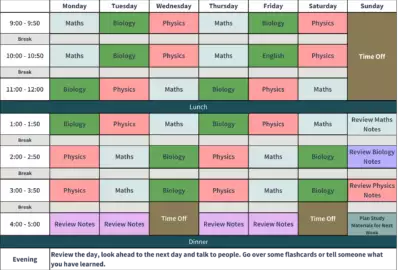
A Simple A Level Economics Revision Timeline
Autumn term of Year 13: keep Year 12 topics ticking over while you learn new content. Build your diagram bank and start your examples notebook.
Christmas holidays and mocks: use your mock results to update your green, amber and red list. This is your most useful piece of data all year.
Spring term: move on to regular past paper questions, focusing on your weaker topics and on essay technique.
Easter holidays: full timed papers, plenty of diagram practice, and a first read through your examples notebook.
Exam season: short, focused sessions. Revisit your repeat mistakes list, practise multiple choice questions, and rehearse essay plans rather than writing out full essays.
13.0 Top
Common Mistakes to Avoid
Drawing a diagram and never referring to it in the answer. (The blog writer did this early in their revision, which is why we're putting it first!)
Writing everything you know about a topic rather than answering the question asked.
Ignoring the extract or data in data response questions.
Leaving evaluation until the final paragraph and running out of time.
Revising micro and macro as if they are two separate subjects.
Forgetting to learn the key definitions, which are some of the easiest marks on the paper.

Exam Day
You have made it! By now the hard work is done, so the focus is simply on giving yourself the best chance to show what you know. Get a good night's sleep, eat a proper breakfast and try not to cram new topics on the morning of the exam.
Pack a couple of black pens, a pencil, a ruler and a rubber for your diagrams, and an approved calculator. When the paper starts, take a minute to read the questions, plan your essays briefly before you write, and keep an eye on the clock. A finished paper with slightly shorter answers will almost always score better than a beautiful essay followed by blank pages.
15.0 Top
FAQs
It is challenging, but manageable with the right approach. Most students find that the theory makes sense fairly quickly. The harder part is learning to apply, analyse, and evaluate it under exam conditions: a skill that improves with regular practice.
You need to be comfortable with GCSE-level maths, and if you are brave enough to take on A-Level Economics, then you probably are. You'll encounter questions involving percentages, percentage changes, index numbers and reading graphs. At least 20% of the marks involve quantitative skills, but you will not need advanced maths. If you are planning to study Economics at university, taking A Level Maths as well is strongly recommended.
The earlier the better, but it does not need to be intense from day one. Short, regular review sessions from the start of Year 13, building up to full past papers after your mocks, works well for most students.
Supply and demand, externalities, cost and revenue curves, and AD/AS diagrams appear most often. If you can draw these confidently and explain every shift, you will be in a strong position across all three papers.
Aim for two or three solid examples for each major topic. Quality matters more than quantity, so focus on examples you understand well enough to link clearly to the theory.
If you're studying at a college or sixth form, you don't really have a choice of which exam board you take. But the good news is that none of them is easier or harder overall. The content is very similar, and grade boundaries are set to keep standards consistent. What matters is getting familiar with the question styles and mark schemes for yourboard.
For many students, yes. A tutor can spot gaps in your understanding quickly, give detailed feedback on essays and diagrams, and help you build the evaluation skills that are hard to develop on your own. At Ivy Education, our tutors are experienced with all the major exam boards and tailor every session to the individual student.

Conclusion
A Level Economics rewards students who understand the theory, practise their diagrams, and learn to explain and judge rather than simply describe. Get to know your specification, build strong chains of analysis, keep an eye on the news and make evaluation a habit, and you will walk into the exam hall feeling ready.
We hope this guide has helped to make revision feel a little less daunting. Good luck!
Please note: the exam dates in this guide are based on the exam boards' published summer 2027 timetables and may be subject to change. Always check your personal exam timetable with your school or college before making plans.

BY Alastair
Alastair Delafield is the Managing Director and founder of Ivy Education.
All Author PostsOther Articles

A Level Grades Explained

What are A-levels?

A Level Results 2026 Analysis

Hardest A Levels 2027
Free A Level Revision Timetable Template

GCSE to A Level Transition: A Survival Guide

A Complete Guide to Every A Level Exam Board

A Level Maths Revision: The Ultimate Guide

How to Prepare for A Levels: A Back-to-School Guide
As featured in