Expert Insights
GCSE to A Level Transition: A Survival Guide
Published 28th August 2026 by Joani Kruger

Leaving GCSEs behind and starting A-Levels is one of the biggest academic transitions students make.
The jump is real: you'll study fewer subjects, but in far greater depth, you'll be expected to work much more independently, and teachers will assume you're ready to take responsibility for your own learning. The good news is that it's a challenge thousands of students successfully make every year. With the right preparation and good habits, you can arrive in September feeling confident rather than overwhelmed.
The weeks between finishing your GCSEs and starting Year 12 are your secret advantage. You don't need to spend the summer revising for hours every day, but a little preparation now can make the first term significantly less stressful.
In this guide, we'll explain what really changes between GCSEs and A-Levels, how to use your summer wisely, subject-specific preparation tips, and the study habits that help students stay ahead from the very beginning.
Before we begin...

The most obvious change is that you'll study fewer subjects. While this might sound easier, each subject is explored in much greater depth. Topics that took one or two lessons at GCSE may now be covered over several weeks, and you'll be expected to understand not only how something works, but why. For example, in GCSE Biology you might learn the stages of photosynthesis. At A-Level, you'll examine the biochemical processes involved, analyse experimental evidence and apply your understanding to unfamiliar scenarios.
The second major difference is the level of independent study expected. This is probably the single most difficult change that students need to adapt to as soon as possible, or they will fall behind. No more hand-holding. Teachers won't constantly remind you about every deadline or check that you've revised each evening. Instead, they'll expect you to use your free periods productively, complete wider reading and identify areas you don't understand before they become bigger problems.
Critical thinking also becomes much more important. Instead of recalling facts, you'll often need to evaluate evidence, compare viewpoints, justify conclusions or solve unfamiliar problems using knowledge you've already learned. This shift catches many students by surprise, especially during the first half term.
Finally, Year 12 usually introduces free periods. While they might initially feel like extra time to relax, successful students treat them as valuable study sessions. Using even half of your free periods effectively can dramatically reduce stress when coursework, tests and mock exams begin to pile up.
The transition can feel challenging, but knowing what to expect puts you one step ahead of many students!
Many students worry they'll "forget everything" if they stop studying altogether. Others jump straight into buying A-Level textbooks and attempting to teach themselves the new course. Neither approach is particularly helpful.
Our educational experts generally recommend striking a balance. Rest properly for the first few weeks, then spend a couple of hours each week gently preparing for September. This light preparation keeps your brain engaged without turning your summer into another exam season.
Here are some productive ways to prepare:
Every exam board publishes a specification explaining exactly what you'll study over the next two years. Rather than trying to memorise the content, use the specification as a roadmap. It shows you how the course is organised, introduces the terminology your teachers will use and helps you understand what you'll be expected to learn. You can download your specification directly from your exam board, such as AQA, Pearson Edexcel, OCR or WJEC.
One of the most valuable things you can do before starting Year 12 is familiarise yourself with your subject's Assessment Objectives (AOs). These explain the skills examiners are looking for in your answers and form the basis of A-Level mark schemes.
For example, in essay-based subjects, you may be assessed on your ability to analyse evidence, evaluate different viewpoints and construct well-supported arguments, rather than simply recalling facts. In the Sciences and Maths, assessment often focuses on applying knowledge to unfamiliar situations, solving problems and demonstrating clear reasoning.
You don't need to memorise the Assessment Objectives before September, but taking a few minutes to read through them alongside your exam board specification can give you a much clearer understanding of what success at A-Level looks like. This can help you develop effective study habits from the very start of the course.
If you're studying History, read a popular history book related to one of your topics. If you've chosen English Literature, read some of the texts in advance if they're already available. Future scientists might enjoy documentaries or introductory lectures from universities.
The goal isn't to memorise content but to develop curiosity.
A-Level courses assume you've already mastered GCSE content. If there were topics you found difficult, particularly in Maths or the Sciences, now is the perfect time to revisit them. Spending an hour strengthening weak foundations is often far more valuable than trying to learn new material.
Many universities upload public lectures to YouTube, while organisations such as the Royal Institution and the BBC produce excellent educational content. Watching a few lectures can help you see how your subjects connect to the real world and develop the deeper thinking expected at A-Level.
Avoid creating a rigid revision timetable over the entire summer. The purpose of the holidays is to recharge as well as prepare. Arriving in September motivated is far more valuable than arriving exhausted.

Maths moves quickly from the very first lesson.
Students should be completely comfortable with GCSE algebra, simultaneous equations, graphs, indices, surds, trigonometry and functions before September. Almost every new topic builds directly on these skills.
If you've chosen Further Maths, a strong Grade 7 or above at GCSE is usually expected, and many schools recommend Grade 8 or 9.
Biology, Chemistry and Physics all involve much greater depth than their GCSE equivalents.
Refresh key concepts such as atomic structure, energy transfers, genetics, chemical calculations and forces. Students also encounter considerably more mathematical problem-solving than many expect, particularly in Chemistry and Physics.
Practising calculations, rearranging formulae and working confidently with units can give you a real advantage.
History, English Literature, Politics, Psychology and similar subjects reward strong written communication.
Rather than writing full essays all summer, try reading high-quality articles, analysing arguments and practising planning essay structures. Learning how to build a well-supported argument is often more valuable than memorising facts.
If you're studying a language, consistency matters more than intensity.
Watch films, listen to podcasts, read news articles or use language-learning apps to keep your vocabulary fresh over the summer.
A handful of sessions with our A-Level tutors can help identify GCSE knowledge gaps before Year 12 begins, giving you greater confidence as you start new subjects.

Choose a clear system for each subject, whether that's folders, colour-coded notes or digital organisation.
Don't wait until mock exams to organise months of loose papers. Track homework, coursework deadlines and upcoming assessments in one place.
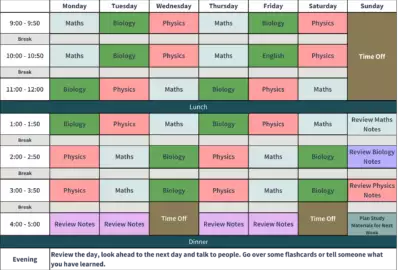
If you are the kind of person who struggles with independent revision, a good way to hold yourself accountable is to organise study time and discuss topics with peers during your free periods (as long as you don't spend that time gossiping or talking about last Sunday's footie match).
Schedule 5-minute chats with your teacher for advice and guidance, or ask your parents to hold you accountable for actually revising at home in the evenings and at weekends when you have time. Having a network that can help you keep on track will stop you from becoming apathetic toward independent study.
Free periods aren't "free" in the sense many Year 11 students imagine. Treat them as scheduled study sessions. That's what they are.
Completing homework, reviewing lesson notes or reading ahead during school hours leaves your evenings much less stressful.
This is based on experience from our blog writers and many students we tutor: If you are naturally smart, coasted through your GCSEs with little revision, got decent grades, and think you can treat A Levels the same, you will get a nasty surprise at the end of your first year mocks. Take A Levels seriously.
One misunderstood lesson can quickly become several misunderstood topics. If something doesn't make sense, ask your teacher, classmates or tutor as soon as possible. Waiting until revision season rarely works because A-Level subjects build continuously upon earlier knowledge.
Spending twenty or thirty minutes reviewing each subject every week is far more effective than trying to relearn everything before exams. This regular review strengthens long-term memory and makes revision significantly easier later.
Perhaps the biggest difference between GCSE and A-Level success is consistency.
A-Level exams test two years' worth of learning. Students who keep pace throughout Years 12 and 13 generally experience much less pressure than those who rely on last-minute revision.
Our expert tutors and consultants often tell our students that the biggest surprise isn't that A-Levels are harder. It's that nobody chases you to stay organised. Students who build good routines in September almost always feel more confident by Christmas.

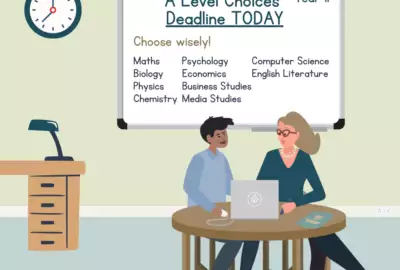
Many students discover that a subject isn't quite what they expected, while others develop new interests after starting sixth form. Fortunately, most schools allow students to switch subjects during the opening weeks of term.
However, this opportunity doesn't last forever. Once several weeks have passed, changing subjects becomes increasingly difficult because you'll already have missed important teaching. If you're genuinely unhappy with one of your choices, speak to your teachers or sixth form tutor as early as possible. They can discuss your options before you fall behind.
When choosing A-Levels, try to focus on three things (in order of priority):
Avoid choosing subjects simply because your friends are taking them or because someone else says they're "easy". Enjoyment and motivation usually lead to better performance over a two-year period.

The transition from GCSE to A-Level is a step up, but it doesn't need to be intimidating. Understanding what changes, using the summer wisely, strengthening your GCSE foundations and building consistent study habits will put you in a strong position from the very beginning of Year 12.
Remember that nobody starts A-Levels knowing everything. The students who thrive aren't those who never struggle; they're the ones who ask questions early, stay organised and keep working steadily throughout the course.
If you'd like extra support before Year 12 begins, our expert tutors can help you build confidence and start your A-Level studies on the strongest possible footing.
Yes, yes, it is. Really. A-Levels involve much greater depth, more independent learning and significantly higher expectations for critical thinking. However, students who understand these changes early usually adapt quickly.
Start by taking a proper break after GCSEs. Later in the summer, spend a couple of hours each week refreshing important GCSE topics, reading around your subjects and familiarising yourself with your exam board specifications.
If your summer starts to feel like another exam period, you're probably doing too much. Light preparation is beneficial, but constant revision can leave you tired before Year 12 even begins.
Focus on mastering GCSE algebra, graphs, trigonometry, functions and equations. A-Level Maths assumes these skills are secure and moves quickly from the first lesson.
Strengthen your GCSE understanding of key concepts, particularly calculations, units and mathematical problem-solving. Reading around scientific topics can also help develop the deeper understanding expected at A-Level.
Usually, yes. Most schools allow changes during the first few weeks of Year 12. Speak to your teachers as soon as possible if you're unsure, as switching becomes much harder once significant content has been covered.
Outside lesson time, many schools recommend around four to five hours of independent study per subject each week. This varies between students, but consistent weekly study is much more effective than last-minute cramming.
The most common mistakes include wasting free periods, leaving difficult topics until revision season, assuming GCSE study habits will still be enough, and trying to catch up after falling behind instead of asking for help early.