A Level Chemistry Tuition: Expert Physical, Inorganic and Organic Tutors
Bespoke one-to-one A Level Chemistry tuition, in person across London and online across the UK. Our handpicked tutors cover every board, including AQA, Edexcel, OCR A and OCR B (Salters), and support students through the content, the calculations, the required practicals and the exam technique that decides the top grades.
Talk to our experts today:





Meet Our A Level Chemistry Tutors
Our A Level Chemistry tutors are subject specialists with years of sixth-form teaching behind them. Many hold degrees in Chemistry, Natural Sciences, Chemical Engineering, Biochemistry or Medicine from leading universities; several are qualified teachers, a number hold doctorates, and some have examining experience. Every tutor is selected individually through a rigorous vetting process, and only a small proportion of applicants join us.

Amina
Biology GCSE SpecialistAmina is a warm, passionate, and meticulous tutor. Having completed five years of Medical School examinations at Imperial College London, she uses her years of experience to expert...

Dr Pegin P.
University Admissions SpecialistDr. Pegin provides comprehensive support across the full medical admissions pathway, including UCAT preparation, personal statements, interview preparation (MMI and panel), and str...

Kate
Biology & Science SpecialistKate is highly experienced in supporting students through GCSE, IGCSE, A Level, and International Baccalaureate Biology (SL and HL), as well as ESS and SEHS, providing strong acade...

Dr Harindi J.
University Admissions SpecialistHarindi is is particularly well-suited to students pursuing medicine and other competitive STEM pathways, providing strong academic foundations in core sciences alongside structure...

Holly
GCSE Science SpecialistHolly brings a unique and effective tutoring style to the table, blending a wealth of knowledge with personalised guidance. Whether introducing fundamental concepts or delving into...

Phoebe
University Admissions: Oxbridge, Science, Biology, GeographyPhoebe has tutored since 2014 and has extensive teaching experience with students from the age of 4 up to adults. She has had the pleasure of working with students across the globe...

Jessica
Medicine & STEMJessica provides comprehensive, step by step university guidance tailored to each student’s ambitions and academic profile. This includes strategic university and course selection,...

Ayman
University Admissions SpecialistAyman combines strong academic excellence with over 300 hours of tutoring experience across GCSE, A Level, and university application preparation, working with both private clients...

Dr Shreema
University Admissions SpecialistWith an exceptional academic background including a BSc in Biological Chemistry, an MRes in Clinical Drug Development, and a PhD in Oncology, she brings deep subject expertise and ...
Hand-Picked A-Level Chemistry Tutors For Your Child's Personal Needs
A Level Chemistry is widely regarded as one of the hardest A Levels, and it catches students out for a specific reason: a fifth of the marks require mathematics, and the subject demands that you hold a chemical idea and a calculation in mind at the same time. That's where Ivy Education comes in.
We help students who are:
Stuck on the calculations
A fifth of the marks require mathematics, and moles, equilibrium constants, rate equations and pH are where a good chemist's grade most often stalls.
Aiming for Medicine, Dentistry or Veterinary Science
Chemistry is the near-universal requirement for these courses, and offers of A*AA or AAA usually depend on a passed practical endorsement as well as the grade.
Losing their way in organic mechanisms
Organic chemistry rewards recognising a pattern rather than memorising a list, and students who never make that shift find synthesis routes get harder every term.
Rebuilding after a difficult Year 12
Chemistry builds relentlessly on itself, so a shaky term early on shows up much later. Diagnosed properly, it is usually one or two foundations rather than the whole subject.
Whatever the goal, your family is not working it out alone.
We will find the right tutor and stay involved right through to results day.
The Written Papers and the Practical Endorsement
Every board examines A Level Chemistry through three written papers sat at the end of Year 13, and a separate practical endorsement assessed by your child's teachers across the two years. Our tutors can help with both.
While the endorsement does not contribute to the A*–E grade, many universities — especially in Medicine, Dentistry and Veterinary Science — require a pass as a condition of their offer. Practical skills are also examined in the written papers, and they do affect the grade.
The Written Papers
All boards assess A Level Chemistry through three written papers sat at the end of Year 13. Two cover defined portions of the specification; the third is synoptic and can draw on anything from the two years, usually with a heavy practical and data-analysis component.
At least 15% of the marks assess practical skills, and at least 20% require mathematics at GCSE Higher tier level or above — double the requirement in Biology. Both are examined inside the written papers, so both affect the final grade.
The Practical Endorsement
Alongside the A Level, students complete a set of required practical activities and are assessed by their teachers against the Common Practical Assessment Criteria. This is reported separately and does not contribute to the A*–E grade.
It still matters. Many universities make a passed endorsement a condition of their offer, particularly for Medicine, Dentistry, Veterinary Science and laboratory-based degrees, so it is not something to treat as optional.
What we cover
Atomic Structure and Bonding
Atomic structure, ionisation energies, electron configuration, ionic, covalent and metallic bonding, shapes of molecules, electronegativity, polarity and intermolecular forces. The foundation everything else rests on, and the reason a student who is shaky here struggles in topics that look entirely unrelated.
Amount of Substance and Moles
The mole, relative masses, empirical and molecular formulae, reacting masses, concentrations, the ideal gas equation, percentage yield and atom economy. Introduced early, assumed thereafter, and the single most common reason a capable student's marks stop moving.
Energetics and Thermodynamics
Enthalpy changes, calorimetry, Hess's law, bond enthalpies, Born-Haber cycles, entropy and Gibbs free energy. Heavily quantitative, and an area where students lose marks through sign errors and unstated states rather than misunderstanding the chemistry.
Kinetics and Rate Equations
Collision theory, catalysts, the Boltzmann distribution, rate equations, orders of reaction, the rate-determining step, half-life and the Arrhenius equation. Determining orders from experimental data is a standard exam task and a standard weak point.
Equilibria, Kc and Kp
Reversible reactions, Le Chatelier's principle, calculating and interpreting Kc and Kp, and the effect of changing conditions on both position and constant. Students frequently understand the qualitative principle and then lose every mark on the calculation.
Acids, Bases and pH
Strong and weak acids, pH and Ka calculations, buffers, titration curves and indicator choice. Mathematically demanding, logarithmic, and one of the topics where targeted work produces the fastest visible improvement in a student's marks.
Redox and Electrochemistry
Oxidation numbers, half equations, redox titrations, electrode potentials, electrochemical cells and fuel cells. A topic that rewards a systematic method: students who work to a routine here score consistently, and those who improvise do not.
Inorganic Chemistry and the Periodic Table
Periodicity, Group 2 and Group 7 chemistry, period 3 elements, and transition metals including complex ions, ligand substitution, colour and catalysis. Content-heavy, and the area students most often leave until last and then never quite secure.
Organic Chemistry and Synthesis
Alkanes, alkenes, halogenoalkanes, alcohols, carbonyls, carboxylic acids and derivatives, aromatic chemistry, amines, amino acids, polymers, isomerism and multi-step synthesis routes. The largest single block of content, and one that rewards recognising reaction patterns over memorising reagent lists.
Analytical Techniques
Mass spectrometry, infrared spectroscopy, NMR including proton and carbon-13, and chromatography. Structure determination questions combine several techniques at once and appear reliably in the synoptic paper, where they are very winnable with practice.
Required practicals and the endorsement
A defined set of required practicals runs through the course, and questions about them appear across all three papers. Students are asked about method, apparatus, quantities, safety, percentage error and how to improve a procedure, sometimes for a practical carried out eighteen months earlier. Our tutors revisit each one so the detail is secure for the exam as well as the endorsement.
The mathematics of Chemistry
At least a fifth of the marks require mathematics: moles and concentrations, logarithms for pH and Ka, rearranging the ideal gas equation, gradients and tangents, significant figures, standard form and percentage error. Students routinely understand the chemistry and lose the marks in the arithmetic, the units or the rounding, and those are among the quickest marks to recover.
Not sure which of these your child is struggling with?
Don't worry! Our Education Team will match you with a specialist who can easily identify what areas your child is struggling with.
A Level Chemistry and University Admissions
Chemistry is the gateway subject for Medicine, Dentistry, Veterinary Science and most natural sciences degrees — and for several of those courses, a strong grade is only part of the requirement.
A number of universities also set a separate admissions test, sat in the autumn of Year 13 alongside a full A Level timetable. These are not simply harder Chemistry papers: they reward speed, reasoning and the ability to work with unfamiliar material under sharp time pressure. Students who plan for them early, rather than treating them as a separate problem in September, tend to find each strengthens the other. We run dedicated preparation for all of these and can join it up with A Level tuition where a student needs both.
Beyond the A Level
UCAT
Since the BMAT was withdrawn, the UCAT is the admissions test for every UK medical and dental school, Oxford and Cambridge included. It tests reasoning, decision making and speed rather than Chemistry content, and it is sat over the summer before the UCAS deadline, which makes early planning essential.
UCAT tuition →ESAT
The Engineering and Science Admissions Test is sat by applicants to Cambridge Natural Sciences, Chemical Engineering and Veterinary Medicine, and to science courses at Oxford and Imperial. Candidates take a compulsory Mathematics module plus two chosen modules, and Chemistry is one of them.
ESAT tuition →Applications and interviews
For the most competitive courses the test is only one component. Personal statements, work experience, super-curricular reading and interview technique all carry weight, and Oxbridge science interviews in particular ask students to reason aloud through problems they have never seen.
Medicine admissions →Exam Boards and Specifications
Let us know what exam board your child is taking, and we will match them with a tutor that understands the intricacies of that board. Our tutors are experts at all exam boards, including the ones below:
AQA (7405)
The most widely taken specification. Papers 1 and 2 each run to 105 marks over two hours, covering inorganic and physical, then organic and physical chemistry. Paper 3 is 90 marks and unusual in its structure: 40 marks on practical techniques and data analysis, 20 marks across the specification, and 30 marks of multiple choice. That multiple choice section rewards a different kind of preparation entirely.

Pearson Edexcel (9CH0)
Structured very differently. Papers 1 and 2 are shorter — 90 marks in one hour forty-five minutes each — while Paper 3, General and Practical Principles in Chemistry, runs to 120 marks over two and a half hours and is worth 40% of the whole qualification. Almost half a student's grade sits in one synoptic paper that can draw on anything, which changes how revision should be planned.
OCR A (H432)
A content-led approach and the more widely taught of OCR's two Chemistry specifications. Paper 1, Periodic table, elements and physical chemistry, and Paper 2, Synthesis and analytical techniques, each run to 100 marks over two hours fifteen minutes. Paper 3, Unified chemistry, is a shorter synoptic paper of 70 marks. All three components include synoptic assessment.
OCR B — Salters (H433)
A context-led course, genuinely different from OCR A rather than a variant of it. Chemistry is taught through real applications rather than topic by topic, and the assessment places distinct weight on scientific literacy and on practical skills. Students on this route need preparation built around that structure, not generic A Level Chemistry revision.
International A Level and IB
We also tutor Cambridge International (CAIE) A Level Chemistry and IB Chemistry at both Standard and Higher Level, including the internal assessment. These follow different content, assessment structures and practical requirements from the UK A Level, so preparation is planned around the specification the student is actually sitting.
Not sure which specification your child is taking?
Tell us your child's school when you enquire, and we will establish which board and route they are on, then match them with a tutor who teaches it every week.
A Level Chemistry Tuition: Online and In-Person
We provide one-to-one online A Level Chemistry tuition to families across the UK and internationally.
We are based in Fulham and can provide in-person tutors across West, South-West and Central London. A Level Chemistry also works particularly well online: lessons run over video with a shared whiteboard, so tutor and student can work through a Born-Haber cycle line by line, build a mechanism arrow by arrow, set out a Kc calculation, or interpret an NMR spectrum together in real time. Because the working is visible as it is being built, a tutor can see exactly where a method breaks down rather than only seeing the wrong final answer.
Between sessions, students can submit calculation working and past-paper questions for marking against the real mark schemes, so feedback continues through the week rather than stopping when the lesson ends. Online tuition also widens the pool: A Level Chemistry specialists are considerably scarcer than GCSE tutors, and going online means your child is matched with the strongest available tutor for their board and their target grade, wherever that tutor happens to be.

Get in touch with our Family Education Team
Whether your child needs help with physical, inorganic or organic chemistry, the calculations or the required practicals, a quick chat is all we need to find the right tutor for them.
How We Pick Your Perfect A Level Chemistry Tutor

Our dedicated team will provide a personalised experience for your family.
In our initial discussion, we take the time to understand your student: their school and exam board, where they are in the two-year course, their most recent mock, their target grade, and whether they are applying for Medicine, Veterinary Science or another course with a separate admissions test. We will then begin a thorough search on your behalf.

We will select the tutor best suited to your child, both academically and personally.
Equipped with a clear picture of your student's needs, we approach the A Level Chemistry specialists we believe would be the strongest fit, weighing their availability, degree background, examining and sixth-form teaching experience, manner and approach before deciding who to shortlist.

Our Education Team will introduce you to your handpicked tutor.
We send over a shortlist with everything you need to make an informed decision. If you would like further guidance on which tutor would suit your child best, our experts are always reachable by phone or email and are delighted to advise.

Your tutor will create a bespoke A Level Chemistry plan.
In the first sessions, your student's tutor works through a diagnostic across the specification to see which topics are secure and which are not, paying particular attention to the quantitative topics that quietly hold grades back. From there they build a plan by topic and by skill, covering content, the required practicals, the mathematics and extended response technique, reviewed regularly against past-paper performance so progress is visible rather than assumed.

You will receive regular check-ins with our Client Services Team.
From the first lesson through to results day, we stay in touch to make sure the quality and momentum of the tuition are consistent, and that the family, the student and the tutor are all happy with the arrangement.
Our Feedback
Mrs T Brent Cross
Trausti has been perfect. He is so organized, helpful and knowledgeable and very patient. He clearly has a deep understanding of the curriculum and teaches it in such a way that my daughter has really improved significantly and is now on course to achieve the grade she wants in Maths. What has been so impressive is his ability to identify the areas that require work and after assessing to improve these "dodgy" areas with practice papers and tuition. He is meticulous and that is what is required at this stage - he is much appreciated!”
Mr B London
"E was an excellent choice for A. Knowing that he is a kinaesthetic learner she went to great lengths to enhance his learning through diagrams and activities. She also ensured plenty of breaks when she saw A's concentration lagging. The proof for me was seeing A really enjoy the lessons which is great given that Biology & Chemistry are subjects he finds really challenging!"
Mrs D-B Clapham
"Harmish impressed me; a very focussed together young man, as good at discussing his approach and my daughter's progress with me as he was at engaging with the youngster herself. He dealt with her teenage attitude incredibly well, got her on task and kept her there for the entire session. He told me he is used to teenage girls and often helps his younger twin sisters with their work. Clearly something which stands him (and them I suspect) in good stead! He shared some helpful ideas and materials with us as well! I highly recommend Hamish!"
FAQs
Free A Level Chemistry Resources
If you need help with your A Level Chemistry revision, check out our free exam guides, revision guides and other resources below.

A Level Results 2026 Analysis

Hardest A Levels 2027
What makes an A Level hard may depend on individual factors such as a natural aptitude, a preference for certain subjec...
What are A-levels?
Transitioning from the realm of GCSEs to the next stage —A Levels— becomes a critical milestone for UK students aspirin...

A Level Grades Explained
Understanding A Level grades is crucial for students aiming to navigate their educational journey effectively and maximi...
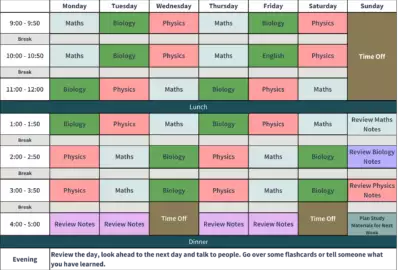
Free A Level Revision Timetable Template
A good revision timetable will ensure you have a plan to cover all the topics you need to cover. You will have been stud...

A Complete Guide to Every A Level Exam Board
Choosing the right A-Level exam board can significantly influence a student’s academic journey. While all boards adhere ...