A Level Biology Tuition: Expert One-to-One Subject Specialists
Bespoke one-to-one A Level Biology tuition, in person across London and online across the UK. Our handpicked tutors cover every board, including AQA, Edexcel, OCR A and OCR B, and support students through the content, the required practicals and the exam technique that decides the top grades.
Talk to our experts today:





Meet Our A Level Biology Tutors
Our A Level Biology tutors are subject specialists with years of sixth-form teaching behind them. Many hold degrees in Biology, Biomedical Sciences, Natural Sciences or Medicine from leading universities; several are qualified teachers, a number are practising or qualified medics, and some have examining experience. Every tutor is selected individually through a rigorous vetting process, and only a small proportion of applicants join us.

Amina
Biology GCSE SpecialistFive years of Medical School examinations at Imperial College London, and over ten years of teaching experience across the GCSE and IGCSE Biology syllabuses.
View profile
Dr Pegin P.
Medicine & Science SpecialistA medical doctor (MBChB, Manchester) who teaches Biology, Chemistry and Maths from Key Stage through to A Level, with a focus on closing conceptual gaps and sharpening exam technique.
View profile
Kate
Biology & Science SpecialistOver 20 years of international teaching, a PGCE in Secondary Science and examiner experience, covering GCSE, IGCSE, A Level and IB Biology at SL and HL.
View profile
Dr Harindi J.
Science SpecialistA PhD in Chemical Engineering and a First Class background in Molecular Biology, with over eight years teaching GCSE and A Level Biology, Chemistry and Physics across all exam boards.
View profile
Holly
GCSE Science SpecialistA PGCE with Distinction and several years teaching Biology, Chemistry and Physics in senior schools, with extensive experience across all GCSE proficiency levels.
View profile
Phoebe
Sciences & Entrance ExamsAn Oxford Human Sciences graduate now completing a PhD in Neuroscience at King's College London, teaching Biology and the sciences alongside entrance exam preparation.
View profile
Jessica
Medicine & STEMTutors Biology, Chemistry and Maths from Key Stage 1 through to A Level, and guides students through Medicine and STEM university applications from start to finish.
View profile
Ayman
Medicine & Science SpecialistA medical student at UCL with A* grades in Biology and Chemistry and eleven grade 9s at GCSE, with over 300 hours of tutoring across GCSE and A Level Sciences.
View profile
Dr Shreema
Biology & Science SpecialistA qualified teacher and examiner with a PhD in Oncology and more than 4,000 hours of tuition, specialising in Biology for Medicine and science-based degree pathways.
View profileHand-Picked A-Level Biology Tutors For Your Child's Personal Needs
A Level Biology covers a large amount of content, and many students find that the step up from GCSE takes some getting used to. Topics are explored in greater depth, and questions often require students to apply their knowledge in new ways. With the right support and a clear approach to revision, the subject can feel much more manageable.
We help students who are:
Drowning in the volume of content
Biology has more to learn than any other science, and students who relied on memorising it at GCSE often find that strategy stops working somewhere in the middle of Year 12.
Aiming for Medicine, Dentistry or Veterinary Science
These courses routinely ask for A*AA or AAA with Biology and Chemistry, and the offer usually depends on a passed practical endorsement as well as the grade.
Losing marks on extended response
Students who know the content can still lose whole bands of marks by not linking cause to effect in full, or by answering a question the examiner did not ask.
Caught out by the maths and the data
Statistical tests, chi-squared, magnification, rates and unfamiliar graphs surprise students who chose Biology expecting to avoid mathematics.
Whatever the goal, your family is not working it out alone.
We will find the right tutor and stay involved right through to results day.
The Written Papers and the Practical Endorsement
A Level Biology includes both written examinations and a separate Practical Endorsement. While the Practical Endorsement does not contribute to your final grade, developing confidence in practical skills is still an important part of the course. Ivy Education can help with both.
The Written Papers
All boards assess A Level Biology through three written papers sat at the end of Year 13. Two cover defined portions of the specification; the third is synoptic and can draw on anything from the two years, often in a context the student has never seen before.
At least 15% of the marks assess practical skills, and around 10% require mathematics at GCSE Higher tier level or above. Both are examined inside the written papers, so both affect the final grade.
The Practical Endorsement
Alongside the A Level, students complete a set of required practical activities and are assessed by their teachers against the Common Practical Assessment Criteria. This is reported separately and does not contribute to the A*–E grade.
It still matters. Many universities make a passed endorsement a condition of their offer, particularly for Medicine, Dentistry, Veterinary Science and laboratory-based degrees, so it is not something to treat as optional.
What we cover
Biological Molecules
Monomers and polymers, carbohydrates, lipids, proteins, enzymes and enzyme kinetics, nucleic acids, ATP, water and inorganic ions. The foundation the whole course is built on: it reappears inside almost every later topic, so a gap here quietly costs marks in places that look unrelated.
Cells and the Immune Response
Cell structure and ultrastructure, microscopy and magnification calculations, cell fractionation, transport across membranes, the cell cycle and mitosis, and the immune system including antibodies, vaccines and HIV. A topic where precise terminology earns marks that vague description does not.
Exchange and Transport
Surface area to volume ratio, gas exchange in a range of organisms, digestion and absorption, mass transport in animals including the heart and haemoglobin, and transport in plants through the xylem and phloem. Heavy on applying a principle to an unfamiliar organism rather than recalling one example.
Genetic Information, Variation and Biodiversity
DNA and RNA structure, replication, the genetic code, protein synthesis, meiosis and genetic diversity, natural selection, classification and phylogeny, and measuring biodiversity within a community. The point where students first meet the level of detail A Level demands.
Energy Transfers: Photosynthesis and Respiration
The light-dependent and light-independent reactions, glycolysis, the link reaction, the Krebs cycle and oxidative phosphorylation, anaerobic respiration, energy transfer through ecosystems and nutrient cycles. Widely regarded as the hardest content on the course and a common reason a strong student's grade stalls.
Response to Stimuli, Nerves and Muscles
Survival and response, tropisms, receptors, the nervous system, the resting and action potential, synaptic transmission, and the structure and contraction of skeletal muscle. Detailed, sequential processes where students lose marks by leaving a step out rather than by not knowing it.
Homeostasis and Control
Negative feedback, control of blood glucose and the role of insulin and glucagon, diabetes, osmoregulation and kidney function, and control of heart rate. Reliable marks for students who understand the mechanism rather than memorising the diagram.
Genetics, Populations, Evolution and Ecosystems
Inheritance and genetic crosses, the Hardy-Weinberg principle, variation within populations, speciation and genetic drift, populations and ecosystems, succession, and investigating populations in the field. The most mathematically demanding area of the specification.
Gene Expression and Gene Technologies
Mutation, stem cells, control of transcription and translation, epigenetics, cancer, genome projects, recombinant DNA technology, PCR, gene probes and genetic fingerprinting. Modern, fast-moving material often taught last and revised least, and a frequent source of dropped marks in the synoptic paper.
Required practicals and the endorsement
A defined set of required practical activities runs through the course, and questions about them appear across all three written papers. Students are asked about method, variables, controls, apparatus and sources of error, sometimes for a practical they carried out eighteen months earlier. Our tutors revisit each one so the detail is secure for the exam as well as the endorsement.
Maths skills in Biology
Around a tenth of the marks require mathematics: magnification and scale, percentage change, rates from a tangent, standard form, ratios, means and standard deviation, statistical tests including chi-squared and correlation coefficients, and the Hardy-Weinberg equation. Students frequently understand the biology and lose the marks in the arithmetic or the setting out.
Extended response, essays and command words
The longest questions reward a structured explanation that links cause to effect the whole way through, not a list of relevant facts. On some boards this extends to a full essay drawing on the entire specification. Our tutors teach students to read the command word, plan the shape of the answer and write to the mark scheme rather than around it.
Our tutors support the written papers and the practical endorsement.
Whether your child needs to close a content gap, sharpen their exam technique or get the required practicals secure before assessment, our Education Team will find the right specialist for them.
A Level Biology and University Admissions
For Medicine, Dentistry, Veterinary Science and the most competitive science courses, a strong grade is only part of the picture. Several universities also set a separate admissions test.
These tests are not simply harder Biology papers. They reward speed, reasoning and the ability to work with unfamiliar material under sharp time pressure, and they are sat in the autumn of Year 13, alongside a full A Level timetable. Students who plan for them early, rather than treating them as a separate problem in September, tend to find that each strengthens the other. We run dedicated preparation for all of these and can link it to A Level tuition if or when a student needs both.
Beyond the A Level
UCAT
Since the BMAT was withdrawn, the UCAT is the admissions test for every UK medical and dental school, Oxford and Cambridge included. It tests reasoning, decision making and speed rather than Biology content, and it is sat over the summer before the UCAS deadline, which makes early planning essential.
UCAT tuition →ESAT
The Engineering and Science Admissions Test is sat by applicants to Cambridge Natural Sciences and Veterinary Medicine, and to science courses at Oxford and Imperial. Candidates take a compulsory Mathematics module plus two chosen modules, and for the biological routes those are usually Biology and Chemistry.
ESAT tuition →Applications and interviews
For the most competitive courses the test is only one component. Personal statements, work experience, super-curricular reading and interview technique all carry weight, and Oxbridge science interviews in particular ask students to reason aloud through problems they have never seen.
Medicine admissions →Exam Boards and Specifications
Biology has more specifications in circulation than any other A Level science, and they are not interchangeable.
AQA is the most widely taken, but OCR runs two entirely separate specifications, Biology A and Advancing Biology, and Pearson Edexcel also offers two: the context-led Salters-Nuffield course and a more conventional route. A student revising to the wrong specification will cover topics they will never be examined on and miss ones they will. If you are not sure which exam your child is sitting, tell us the school, and we will find out.
AQA (7402)
The most widely taken A Level Biology specification. Three two-hour papers: Paper 1 covers the first four topics and Paper 2 the last four, each worth 91 marks, while Paper 3 is synoptic across the whole course, worth 78 marks, and ends with a choice of two essay titles worth 25 marks.

OCR A (H420)
The more widely taught of OCR's two Biology specifications. Paper 1 Biological processes and Paper 2 Biological diversity each run to 100 marks over two hours fifteen minutes, and Paper 3 Unified biology is a shorter synoptic paper of 70 marks. A large share of the Paper 3 marks come from interpreting research and data students have never seen before.

Pearson Edexcel (A and B)
Edexcel runs two routes. Biology A, the Salters-Nuffield course, teaches the content through real-world contexts and is popular with schools that want an applied feel. Biology B follows a more conventional topic order. Both end with a synoptic paper covering general and practical principles.
OCR B — Advancing Biology (H422)
A different specification from OCR A, it places weight on scientific literacy and on practical skills, each of which gets its own dedicated paper. Students on this route need preparation built around that structure rather than generic A Level Biology revision.
International A Level and IB
We also tutor Cambridge International (CAIE) A Level Biology and IB Biology at both Standard and Higher Level, including the internal assessment. These differ in content, assessment structures, and practical requirements from the UK A Level, so preparation is planned around the specification the student is sitting.
Not sure which specification your child is taking?
Biology has more routes than any other science, and schools rarely make it obvious. Tell us your child's school when you enquire, and we will establish which one they are on and match them with the perfect tutor.
A Level Biology Tuition: Online and In-Person
We provide one-to-one online A Level Biology tuition to families across the UK and internationally.
We are based in Fulham and can provide in-person tutors across West, South-West and Central London. A Level Biology also works well online: lessons run over video with a shared whiteboard, so tutor and student can build a nephron diagram together, annotate an unfamiliar graph, or plan the structure of a six-mark answer point by point before writing it.
Between sessions, students can submit written answers and past-paper questions for marking against the real mark schemes, which matters more in Biology than in most subjects — the gap between an answer that feels right and one that scores is usually in the wording. Online tuition also widens the pool: your child is matched with the strongest available specialist for their board and their target grade, wherever that tutor happens to be.

Get in touch with our Family Education Team
Whether your child needs help with the content, the required practicals or the extended response questions, a quick chat is all we need to find the right tutor for them.
How We Pick Your Perfect A Level Biology Tutor

Our dedicated team will provide a personalised experience for your family.
In our initial discussion, we take the time to understand your student: their school and exam board, where they are in the two-year course, their most recent mock, their target grade, and whether they are applying for Medicine, Veterinary Science or another course with a separate admissions test. We will then begin a thorough search on your behalf.

We will select the tutor best suited to your child, both academically and personally.
Equipped with a clear picture of your student's needs, we approach the A Level Biology specialists we believe would be the strongest fit, weighing their availability, degree background, examining and sixth-form teaching experience, manner and approach before deciding who to shortlist.

Our Education Team will introduce you to your handpicked tutor.
We send over a shortlist with everything you need to make an informed decision. If you would like further guidance on which tutor would suit your child best, our experts are always reachable by phone or email and are delighted to advise.

Your tutor will create a bespoke A Level Biology plan.
In the first sessions, your student's tutor works through a diagnostic across the specification to establish which topics are genuinely secure and which only feel familiar — a distinction that matters more in Biology than in any other science. From there they build a plan by topic and by skill, covering content, the required practicals, the mathematics and extended response technique, reviewed regularly against past-paper performance so progress is visible rather than assumed.

You will receive regular check-ins with our Client Services Team.
From the first lesson through to results day, we stay in touch to make sure the quality and momentum of the tuition are consistent, and that the family, the student and the tutor are all happy with the arrangement.
Our Feedback
Mrs T Brent Cross
Trausti has been perfect. He is so organized, helpful and knowledgeable and very patient. He clearly has a deep understanding of the curriculum and teaches it in such a way that my daughter has really improved significantly and is now on course to achieve the grade she wants in Maths. What has been so impressive is his ability to identify the areas that require work and after assessing to improve these "dodgy" areas with practice papers and tuition. He is meticulous and that is what is required at this stage - he is much appreciated!”
Mr B London
"E was an excellent choice for A. Knowing that he is a kinaesthetic learner she went to great lengths to enhance his learning through diagrams and activities. She also ensured plenty of breaks when she saw A's concentration lagging. The proof for me was seeing A really enjoy the lessons which is great given that Biology & Chemistry are subjects he finds really challenging!"
Mrs D-B Clapham
"Harmish impressed me; a very focussed together young man, as good at discussing his approach and my daughter's progress with me as he was at engaging with the youngster herself. He dealt with her teenage attitude incredibly well, got her on task and kept her there for the entire session. He told me he is used to teenage girls and often helps his younger twin sisters with their work. Clearly something which stands him (and them I suspect) in good stead! He shared some helpful ideas and materials with us as well! I highly recommend Hamish!"
FAQs
Free A Level Biology Resources
Free A Level Biology Resources Lead: If you need help with your A Level Biology revision, check out our free exam guides, revision guides and other resources below.

A Level Results 2026 Analysis
Hardest A Levels 2027
What makes an A Level hard may depend on individual factors such as a natural aptitude, a preference for certain subjec...
What are A-levels?
Transitioning from the realm of GCSEs to the next stage —A Levels— becomes a critical milestone for UK students aspirin...

A Level Grades Explained
Understanding A Level grades is crucial for students aiming to navigate their educational journey effectively and maximi...
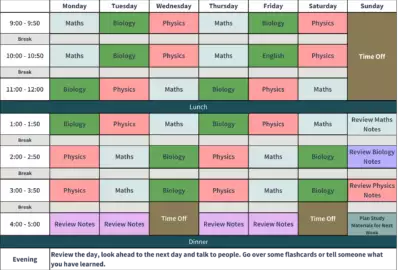
Free A Level Revision Timetable Template
A good revision timetable will ensure you have a plan to cover all the topics you need to cover. You will have been stud...

A Complete Guide to Every A Level Exam Board
Choosing the right A-Level exam board can significantly influence a student’s academic journey. While all boards adhere ...