Expert Insights
How to Write a Medicine Personal Statement (2028 Entry)
Published 16th October 2026 by Ciaran Chillingworth

A medicine personal statement for 2028 entry is made up of answers to three set UCAS questions.
The three answers share a 4,000-character limit, and each must be at least 350 characters. Students in Year 12 now will write it over the coming year and submit it in autumn 2027. The medicine deadline is usually mid-October, a full three months earlier than most other courses.
Medical schools read the statement for evidence of the values and qualities agreed by the Medical Schools Council, and above all for honest reflection on what a candidate has seen and learnt about medicine. The good news for Year 12 families is that the most useful preparation happens now, through work experience, volunteering and reading. This guide explains how the questions work, how medical schools use the answers, and how to plan the year ahead.
Before we begin...
Until the 2026 cycle, applicants wrote one continuous essay. UCAS replaced it with three questions and describes this as the format for 2026 entry onwards, so families applying for 2028 entry should expect the same structure. The overall limit of 4,000 characters, including spaces, has not changed. What universities expect to see has not changed either.
Admissions staff still read the three answers together as one statement, so the candidate does not need to repeat a point across sections. UCAS has also said there is no wrong place to put a piece of evidence. A work experience placement can appear under question one or question three, as long as it is only mentioned once.
| UCAS question | What medical schools want to see | Suggested share of 4,000 characters |
|---|---|---|
| 1. Why do you want to study this course or subject? | A realistic, well-informed reason for choosing medicine, backed by specific moments, reading or conversations | Around 1,100 |
| 2. How have your qualifications and studies helped you to prepare for this course or subject? | Links between school subjects, projects or competitions and the study of medicine, plus study habits that will cope with a demanding course | Around 800 |
| 3. What else have you done to prepare outside of education, and why are these experiences useful? | Work experience, volunteering, part-time work or caring roles, with clear reflection on what each taught candidate about medicine and about themselves | Around 2,100 |
UCAS does not set a maximum for any single question, so the split above is a starting point. Most medicine applicants need more space for question three, because that is where reflection on work experience is usually written about.
| Medical school | How it says it uses the personal statement |
|---|---|
| University of Oxford | Not formally scored but read carefully. UCAT and GCSEs mainly decide shortlisting, and the statement becomes more important if an applicant is not shortlisted on those alone. It is likely to shape interview questions. |
| Brighton and Sussex Medical School | Not read or used at any point in undergraduate admissions. |
| Hull York Medical School | Not scored, but described as an important part of the application. |
| University of Edinburgh | Not formally assessed, but may guide shortlisting for Assessment Days and used as preparation for them. |
| University of Aberdeen | Assessed during the interview if the applicant is invited. |
Two things follow from this. First, check each medical school’s own admissions page when the candidate draws up a shortlist, as policies change between cycles. Second, write every line as if an interviewer will ask about it, because at most medical schools one of them will.
The Medical Schools Council (MSC) publishes a list of skills and attributes agreed by all UK medical schools. It is worth reading in full with the candidate before they plan their work experience, not only before they start writing. The list includes:
The MSC’s advice is to give examples of these qualities rather than claim them. “I am a good communicator” tells the reader very little. A sentence about explaining a care home’s lunch menu to a resident with hearing loss, and what the candidate changed after the first attempt went badly, tells them a great deal.
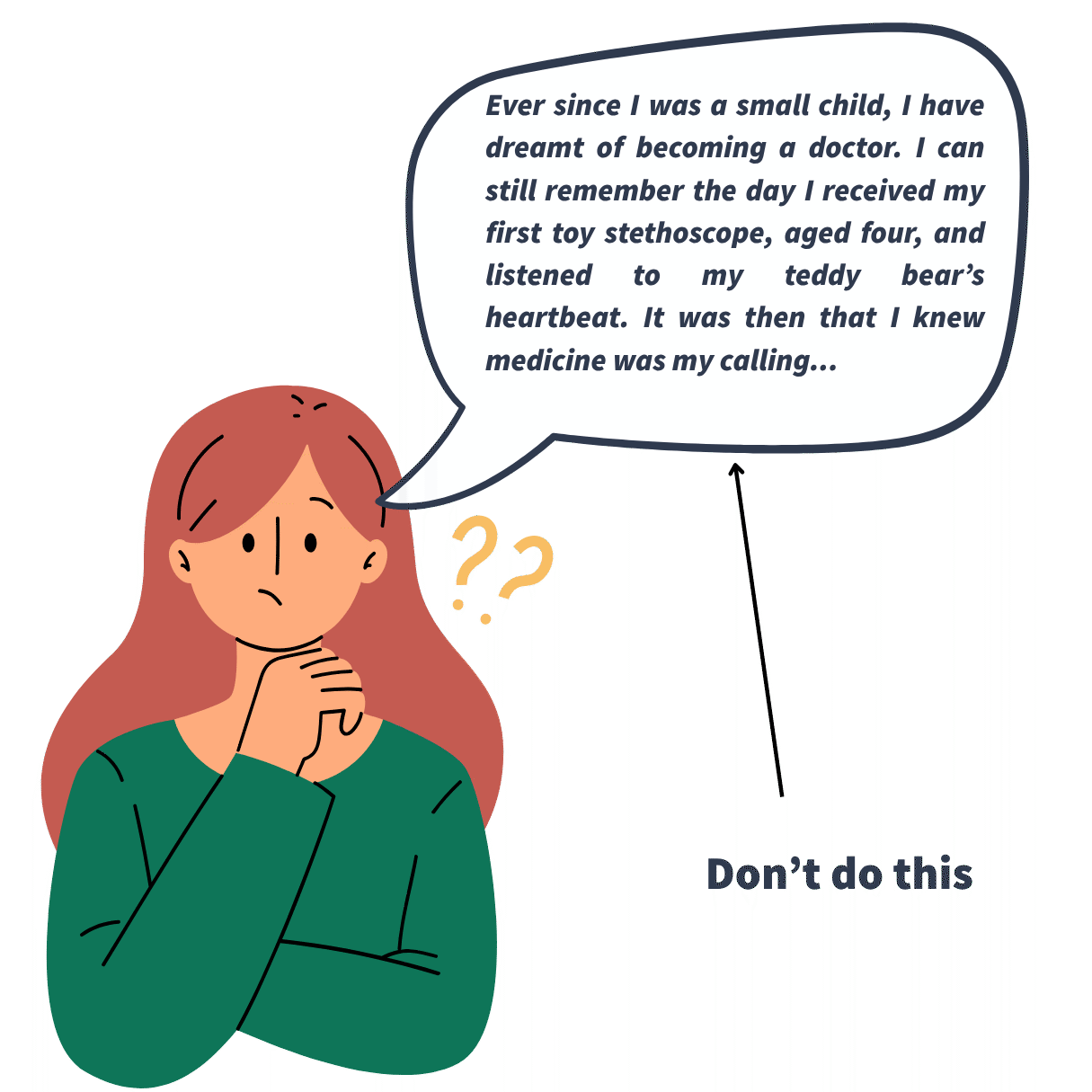
Skip the dramatic opening. Oxford’s own annotated example statement warns that tutors may be sceptical of exaggerated stories about a sudden revelation or a lifelong wish to be a doctor. A calm, specific opening does the job better.
Show a realistic view of the job. Medical schools want applicants who know what they are signing up for. That includes long training, shift work, uncertainty, difficult conversations with patients and the emotional weight of the work. The candidate does not need to dwell on the hard parts, but showing they have thought about them is a sign of maturity.
Be specific. Strong answers usually mention one or two concrete things: a conversation with a junior doctor about rotations, a GP explaining why she chose general practice, or a topic the candidate read about and followed up. The test is whether another applicant could have written the same sentence. If they could, it needs more detail.
Use super-curricular reading well. Books, lectures and online courses only help if the candidate says what they thought. One sentence on what they read, followed by two on what it made them question, is worth more than a list of five titles. Year 12 is the right time to start, as the reading has time to shape the candidate’s thinking before they write about it.
Good material includes:
It is also a good place to show personal organisation. Medicine is a heavy course, and a short example of how the candidate manages a full timetable alongside other commitments speaks to that directly.
If you or someone in your family would like one-to-one support with planning their application, our medicine personal statement admissions support team works with students from Year 12 onwards on every stage, from work experience planning and UCAT preparation to the personal statement and interviews.

The MSC does not set a minimum amount of work experience. Its guidance focuses on what applicants learn from it, and says there is little benefit in repeating the same type of experience. It also says medical schools do not generally encourage overseas clinical work experience. Edinburgh’s admissions page puts the same point plainly: it values quality of experience over quantity.
Useful experience comes in many forms:
Hospital shadowing is hard to arrange for many students, and medical schools know this. Six months of weekly volunteering in a care home often gives a student more to reflect on than a single week watching operations. Starting a regular commitment this term means the candidate will have most of a year of experience to draw on by the time they write.
Hobbies and interests belong here too. Medical schools want to see that applicants have a life outside study and ways of managing pressure. A team sport, music or a part-time job can show teamwork, commitment and resilience if the candidate explains what it has given them.
The MSC and RCGP produce a free work experience reflective diary. Encouraging the candidate to fill it in during each placement makes this section far easier to write next summer.
| Descriptive (weaker) | Reflective (stronger) |
|---|---|
| I spent a week shadowing a GP and saw many different patients. | Shadowing a GP, I saw her spend most of one appointment on a patient's worries about his job rather than his blood pressure. It changed how I think about what a consultation is for. |
| I volunteer at a care home every Saturday, which has improved my communication skills. | One resident with dementia became upset each time I asked about her family. A carer suggested I talk about her garden instead. I now listen for what someone wants to talk about before I steer the conversation. |
| I work at a supermarket, where I learnt teamwork. | On busy shifts I rely on colleagues to cover the tills while I handle complaints. Learning to ask for help early, rather than once a queue has built up, is a habit I expect to need on a ward. |
The reflective versions are not much longer, but each one tells the reader something about how the applicant thinks.
UCAS accepts that AI tools can help with brainstorming ideas, suggesting structure or checking readability. It warns that submitting AI-written text as your own could be treated as cheating and could cost an applicant their offers.
Honesty matters even more in medicine. Oxford says it may check claims made in the statement, and that fabricated or exaggerated material, even if discovered after a student has started the course, may call into question their suitability to practise medicine.
| Stage | Likely timing for 2028 entry | 2027 entry date, for reference |
|---|---|---|
| Work experience, volunteering and wider reading | Now until summer 2027 | Not applicable |
| UCAS applications open | May 2027 | 12 May 2026 |
| UCAT registration opens | May 2027 | 20 May 2026 |
| UCAT testing window | July to September 2027 | 13 July to 24 September 2026 |
| First full draft of the personal statement | Summer holidays 2027 | Not applicable |
| UCAS deadline for medicine | Mid-October 2027 | 6pm, 15 October 2026 |
| Medicine interviews | Usually December 2027 to March 2028 | Dates vary by medical school |
Check UCAS, the UCAT website and each medical school’s admissions page once the 2028 entry dates are confirmed, usually in the spring before applications open.

A strong medicine personal statement is specific, honest and reflective. The three-question format makes it easier to plan, but the basics have not changed. Medical schools want to know why your child has chosen medicine, how their studies have prepared them, and what they have learnt from time spent with patients, carers and healthcare staff.
For Year 12 families, the most useful step now is not writing but preparing. Regular volunteering, a reflective diary and some focused reading will give your child far more to say next summer. Medical schools use the statement in different ways, but it is likely to come up at interview, so every line should be something your child can talk about with confidence.
If your child would like help planning their medicine application for 2028 entry, Ivy Education’s medicine admissions team can help from Year 12 onwards.
The statement has a limit of 4,000 characters, including spaces, shared across three UCAS questions. Each answer must be at least 350 characters. UCAS presents this as the format from 2026 entry onwards, so it is expected to apply for 2028 entry.
The medicine deadline usually falls in mid-October. For 2027 entry it was 6pm on 15 October 2026. Families should check the UCAS website once 2028 entry dates are published.
Most students start planning in the summer term of Year 12 and write a first full draft over the summer holidays. Before that, the priority is building up experience and reflective notes to write about. This leaves time for several drafts before school deadlines in September, alongside UCAT preparation.
A sensible starting point is around 1,100 characters for question one, 800 for question two and 2,100 for question three. Medicine applicants usually need more room for question three, where they reflect on work experience and volunteering.
There is no set amount. The Medical Schools Council’s guidance focuses on what applicants learn from their experience rather than how many hours they complete. Regular volunteering in a care setting, explored with reflection, is often more useful than a short hospital placement.
Yes. Medical schools accept virtual work experience, and programmes run by the Royal College of General Practitioners and some medical schools are widely used. It works best alongside some in-person experience with people, such as volunteering or a part-time job.
No. Brighton and Sussex Medical School does not use it at all, while others, such as Oxford, read it and use it to shape interview questions. Check each medical school’s admissions page, as policies can change between cycles.
UCAS says AI can help with brainstorming, structure and checking readability, but the statement must be the applicant’s own words. Applicants must declare that the statement is not copied or generated by AI, and UCAS runs similarity checks on every statement.
And honestly? Using an AI model like ChatGPT to write your personal statement for you isn't just bad, it's obvious.
Would you like me to generate another 10 FAQs for this blog?